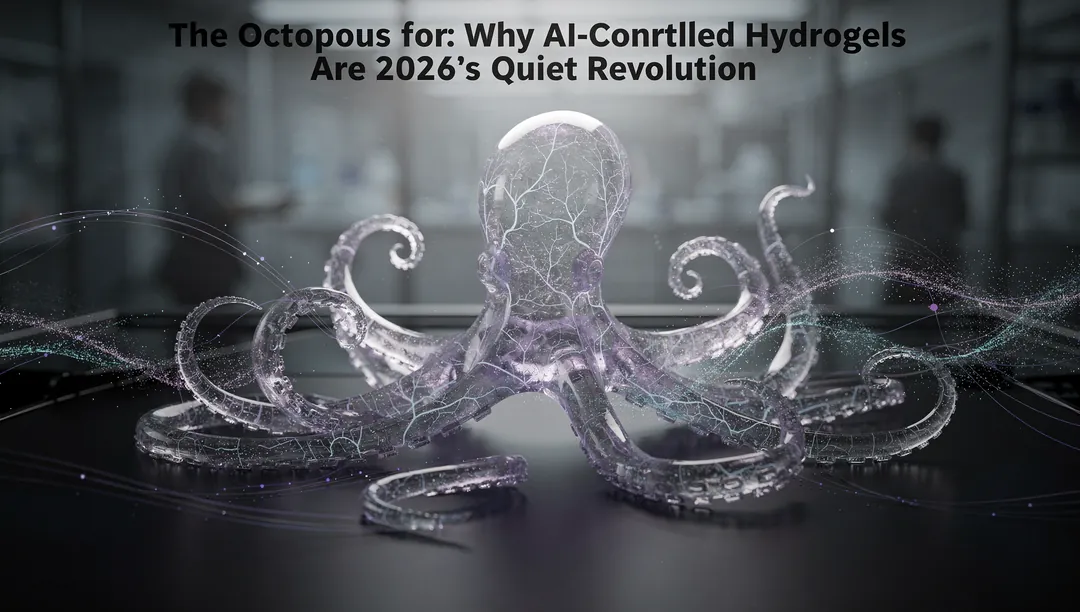
The most elegant robot on Earth is not made of steel, silicon, or lithium—it is ninety-five percent water, changes shape without a single motor, and has been hiding in plain sight for half a billion years. The octopus is not merely an animal; it is a masterclass in distributed, morphological intelligence. Its skin can shift texture and color in milliseconds. Its boneless body can squeeze through gaps no rigid machine could attempt. And crucially, it does not outsource all decisions to a central brain—two-thirds of its neurons reside in its arms, allowing each appendage to compute locally while cooperating with the whole.
In 2026, this biological blueprint is finally meeting its digital counterpart. The convergence of artificial intelligence and smart hydrogels—water-rich polymer networks that respond to external stimuli—is accelerating at a pace that even seasoned robotics researchers find startling. We are no longer talking about simple gels that swell or contract when heated. We are discussing programmable matter: materials whose form, transparency, porosity, and surface texture are governed in real time by machine learning models. The octopus taught us that softness is not a weakness but a strategy. Now, AI is learning to orchestrate that strategy at the molecular level.
The shift now underway is best understood as a transition from reactive chemistry to predictive morphology. Early generations of smart hydrogels operated on direct stimulus-response loops—temperature drops, gel expands; pH shifts, gel releases its payload. Useful, but mechanically rigid in their logic. The integration of AI introduces a layer of anticipatory control. By processing sensory inputs—whether optical, chemical, or mechanical—a neural network can pre-emptively adjust the hydrogel's crosslink density, ionic charge distribution, or embedded microstructure before the environment itself demands the change. The material ceases to be a passive medium and becomes, in effect, a slow-thinking body.
This is where the octopus analogy becomes more than poetic. An octopus does not wait for its central brain to approve every chromatophore expansion; its skin thinks locally. Similarly, the most promising AI-hydrogel architectures emerging this year are exploring distributed inference. Rather than relying on a centralized processor to command every pixel of camouflage or every joint of a soft gripper, researchers are embedding lightweight machine learning models—tiny neural networks running on milliwatts—directly within the material matrix or across mesh networks of micro-actuators. The result is a material that reasons about its own shape. Whether through edge-AI microcontrollers laminated onto hydrogel films or through novel neuromorphic computing elements dispersed throughout the polymer, the goal is the same: reduce the tyranny of latency that has long plagued soft robotics.
Of course, the physics of hydrogels imposes constraints no algorithm can wish away. These materials are diffusion-limited; their movements are governed by the migration of water and ions, not by the instantaneous torque of an electric motor. An AI controller must therefore learn to think in seconds and minutes, not microseconds. It must plan trajectories that account for viscoelastic creep, osmotic pressure, and mechanical hysteresis. In many ways, this has forced the machine learning community to abandon the control paradigms borrowed from rigid industrial robotics and develop entirely new architectures—often inspired by predictive weather modeling or fluid dynamics—to handle the non-linear, history-dependent behavior of soft matter. The challenge is formidable, but the upside is a form of robotic embodiment that is inherently safer, more adaptable, and more energy-efficient than anything built from aluminum and servos.
The applications currently taking shape are as diverse as they are subtle. In agriculture, soft grippers made from AI-modulated hydrogels are being explored for harvesting fragile crops; the material can stiffen to grasp and then soften to release without bruising the fruit. In medicine, the frontier is closed-loop drug delivery, where hydrogel implants interpret biomarker signals through onboard AI and dynamically adjust their porosity to release therapeutics at pharmacologically optimal rates. Environmental engineering points toward adaptive filtration membranes that reconfigure their pore structures in response to shifting contaminant loads, extending operational life without human intervention. And in the more speculative realm of adaptive camouflage, researchers are pursuing e-skin systems that do not merely display color but alter surface topology—mimicking the octopus's papillae—to match visual and tactile backgrounds simultaneously.
Yet with these possibilities come questions that sit uncomfortably at the intersection of ethics and material science. When we embed decision-making algorithms into substances that blur the line between device and tissue, tool and organism, we are forced to ask where agency resides. A hydrogel that reshapes itself based on AI interpretation of its surroundings is no longer a simple instrument; it is a cyber-physical system with a degree of environmental autonomy. If such materials become ubiquitous in architecture, clothing, or surveillance infrastructure, the potential for opaque algorithmic behavior becomes a societal concern. An adaptive wall that changes its thermal properties is benign; an adaptive membrane that decides what molecules to filter based on an opaque neural network raises questions of accountability. Moreover, the embedding of electronics within biodegradable gels creates a tension between the promise of transient, eco-friendly robotics and the reality of e-waste and data extraction.
Another tension lies in the power requirements. Hydrogels are passive by nature; AI is hungry. Bridging this gap remains one of the field's central engineering puzzles. Some research directions favor external fields—magnetic, acoustic, or optical—as both power carriers and control signals, allowing the gel itself to remain free of onboard batteries. Others investigate biohybrid approaches, leveraging microbial or enzymatic reactions within the gel to generate local electrical potentials that feed minimalist neuromorphic circuits. The most elegant solutions, much like the octopus, may turn out to be those that minimize centralized energy dependence in favor of distributed, ambient harvesting.
Looking at the trajectory of 2026, it is clear that AI-controlled hydrogels are transitioning from laboratory curiosities to infrastructural candidates. The next step is unlikely to be a single blockbuster application, but rather a quiet permeation of smart, shape-shifting materials into medical implants, agricultural tools, soft exoskeletons, and environmental sensors. What makes this moment distinct from previous hype cycles in nanotechnology or 3D printing is the reciprocity between the algorithm and the substance: the AI is not merely designing the hydrogel, nor is the hydrogel merely executing AI commands. They are co-evolving. Machine learning is discovering morphologies that human engineers would not intuit, while the material constraints of hydrogels are forcing AI to evolve more embodied, energy-frugal, and temporally patient modes of reasoning.
Key Takeaways
- Predictive Morphology: AI is shifting smart hydrogels from simple stimulus-response materials to anticipatory systems that pre-emptively alter shape, texture, and function based on environmental data, fundamentally changing how we define a "smart" material.
- Distributed Intelligence: Following the octopus model, the field is moving toward embedding lightweight inference directly within material matrices or across micro-actuator networks, reducing latency and enabling local decision-making across soft robotic bodies.
- Physics-Aware Machine Learning: Controlling hydrogels requires abandoning rigid-robotics paradigms; new AI architectures must account for diffusion limits, viscoelasticity, and non-linear material memory, giving rise to novel control theories.
- Cross-Domain Applications: From precision agriculture and closed-loop drug delivery to adaptive environmental filtration and tactile camouflage, the technology is finding footholds in sectors that value gentleness and reconfigurability over speed and brute force.
- Ethical and Energy Challenges: As these materials gain algorithmic autonomy, questions of transparency, e-waste, embedded surveillance, and sustainable power supply must be addressed alongside the technical hurdles of distributed soft systems.
The octopus did not evolve hardness; it evolved strategy. It survived not by resisting its environment, but by becoming infinitely reconfigurable within it. In 2026, AI-controlled hydrogels represent the vanguard of a similar philosophy—not harder machines, but smarter matter. We are building materials that forget the boundary between body and brain, between computing and being. The next decade will likely not deliver a single iconic robot to embody this shift; instead, the transformation will be ambient and invisible, seeping into medical implants, agricultural fields, and architectural skins. Success will depend not merely on computational power, but on our willingness to let materials think slowly, deform gracefully, and disappear into their surroundings. The ocean wrote the original code over five hundred million years. We are simply compiling it for a new century.