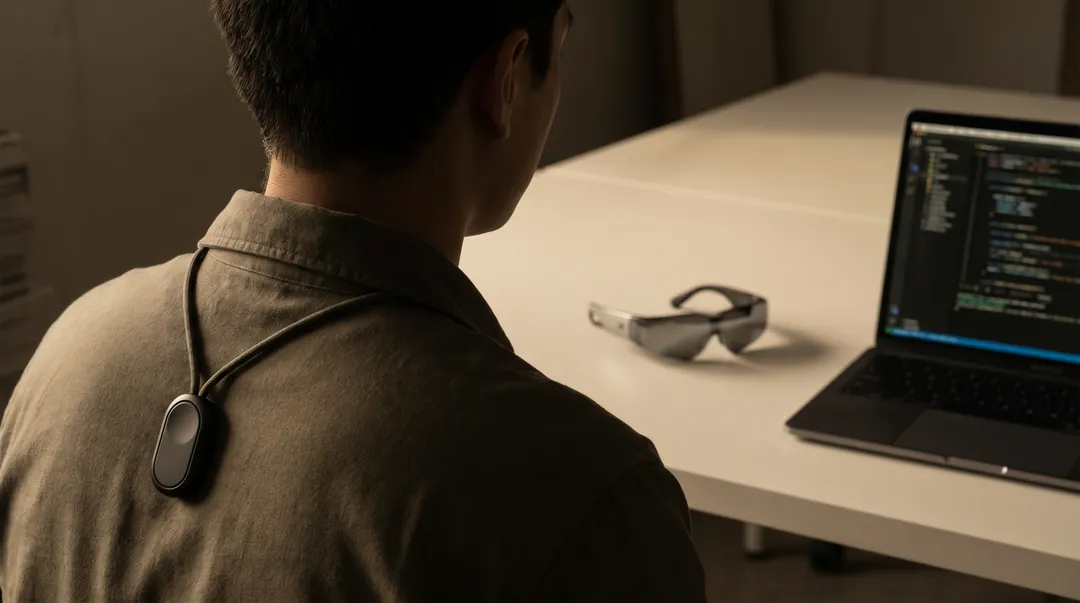
The most revealing thing about Meta's latest wearable strategy isn't what they're building—it's what they're separating. Reports confirm that Meta is developing an AI-powered pendant alongside its expanding glasses portfolio, and launching a business-focused initiative called "Wearables for Work. " On the surface, this looks like simple product diversification. But dig deeper and you'll find a strategic rupture: Meta no longer believes one form factor can rule them all. The glasses and the pendant are diverging because they serve fundamentally different AI interaction models, and that split tells us everything about where ambient computing is heading in 2026.
Why Glasses Alone Weren't Enough
Meta's Ray-Ban smart glasses demonstrated that consumers would tolerate AI on their faces—provided the design didn't scream "cyborg. " The form factor offered obvious advantages: a camera aligned with the user's gaze, speakers near the ears, and a microphone positioned close to the mouth. For quick queries, photo capture, and live translation, glasses made intuitive sense.
Yet glasses carry constraints that no amount of miniaturisation can fully erase. Battery life remains the stubborn bottleneck; processing intensive AI tasks on your face generates heat that becomes uncomfortable after extended use. The optical field is prime real estate, but cramming a display into a lightweight frame still forces compromises between field of view, brightness, and prescription compatibility. And socially, there are contexts—formal meetings, intimate dinners, operating rooms—where wearing camera-equipped glasses raises eyebrows or outright prohibitions.
The pendant sidesteps these limitations entirely. Hung around the neck, it has vastly more volume for batteries and processors. It doesn't obstruct vision or compete with prescription lenses. It can house larger microphone arrays for better far-field voice detection. Most critically, it can be worn discreetly under clothing in settings where facial tech would be inappropriate—the exact environments where "Wearables for Work" is designed to operate.
The Enterprise Angle: Wearables for Work
This is where the strategy gets genuinely interesting. "Wearables for Work" isn't a consumer product with a business sticker slapped on—it reflects a recognition that enterprise AI assistance operates under different rules. In a warehouse, a hospital, or a client meeting, workers need persistent AI support without the social friction of obvious recording devices. A pendant can listen, analyse, and prompt discreetly. It can log meeting summaries, flag safety violations on a factory floor, or guide a technician through complex repairs—all without broadcasting to everyone in the room that you're wearing AI.
From a data perspective, the enterprise play also solves the monetisation puzzle differently. Consumer wearables rely on hardware margins and ecosystem lock-in. Business wearables can justify premium pricing through productivity gains and integrate with existing enterprise software stacks. If a pendant saves a field technician thirty minutes per call, the ROI calculation becomes trivial.
The Divergence Logic
So why not just build a better glasses product that covers both markets? Because the interaction paradigms are pulling in opposite directions. Glasses excel at showing—visual overlays, augmented information, camera-prompted analysis. Pendants excel at listening and speaking—always-on audio AI that responds without requiring you to look at anything. Attempting to merge both into one device produces compromises that satisfy neither use case optimally.
Meta's decision to let these product lines evolve separately suggests the company has internalised a lesson that the industry has been slow to accept: ambient computing isn't one thing. The AI assistant that guides your morning run needs different hardware than the AI that records your board meeting. By decoupling the pendant from the glasses, Meta can optimise each for its core interaction mode rather than forcing users into a one-size-fits-all solution.
There's also a competitive dimension worth noting. Humane's AI Pin demonstrated that neck-worn AI could capture public imagination, even if execution fell short. Apple's continued work on AirPods as health and AI platforms suggests audio-first wearable AI is gaining traction across Silicon Valley. Meta's pendant positions it to compete in a space that glasses alone cannot reach—and ensures it isn't locked out of the audio-centric AI market that competitors are circling.
The Counterargument: Fragmentation Risk
Not everyone is convinced this divergence is wise. Critics argue that splitting the product line fragments developer attention, confuses consumers, and dilutes Meta's brand identity in wearables. If the glasses do X and the pendant does Y, which one should a user buy? The answer "both" is expensive; the answer "it depends" is confusing. There's a genuine risk that Meta ends up with two mediocre product ecosystems instead of one excellent one.
Furthermore, the pendant form factor remains unproven at scale. Neck-worn devices have struggled with social acceptance—early Google Glass wearers faced "Glasshole" stigma, and Humane's Pin attracted curiosity more than adoption. A pendant that's invisible under a shirt solves one problem but creates another: if no one can see it, how does it become a status symbol or conversation starter that drives organic growth?
Key Takeaways
- Form factor divergence reflects interaction divergence: Glasses optimise for visual AI; pendants optimise for audio AI. Meta is betting that neither can fully subsume the other. - "Wearables for Work" targets enterprise pain points: Discreet, always-on AI assistance for professional environments where camera-glasses face social or regulatory barriers. - Competitive hedging: The pendant ensures Meta has a stake in audio-first wearable AI, competing with Apple's AirPods strategy and the broader neck-worn device category. - Fragmentation is the real risk: Two product lines mean split developer resources, consumer confusion, and potential brand dilution if neither achieves dominance.
Looking Ahead
If Meta executes well, the pendant-and-glasses strategy could define the two dominant form factors for ambient AI in the late 2020s. The key variable is whether the enterprise wedge—Wearables for Work—generates enough traction and data to refine the pendant faster than competitors can catch up. Should the business market embrace neck-worn AI assistants for productivity gains, the consumer version will benefit from that maturity. Conversely, if enterprise adoption stalls, the pendant risks becoming a niche experiment while glasses capture the mainstream narrative.
The smarter bet is on divergence persisting. As AI models grow more capable at multimodal reasoning, the hardware that captures the best input—whether visual through glasses or auditory through a pendant—will dictate which form factor wins in each context. Meta's strategy implicitly acknowledges that the future of wearable AI isn't a single device on your face, but a constellation of specialised sensors distributed across your body. The pendant isn't a retreat from glasses; it's an admission that the body has more than one optimal mounting point for intelligence.
I'd be happy to complete the article, but I need the actual content that was cut off. The fragment you've provided only contains "---" which doesn't include any of the previous article text.
Could you please provide:
- The article text that precedes the cutoff point
- The topic or subject matter being covered
- Any context about the article's focus (news, science, AI, ethics, deep-dive)
Once I have this information, I can seamlessly continue the article with proper analysis, Key Takeaways, and a forward-looking conclusion.