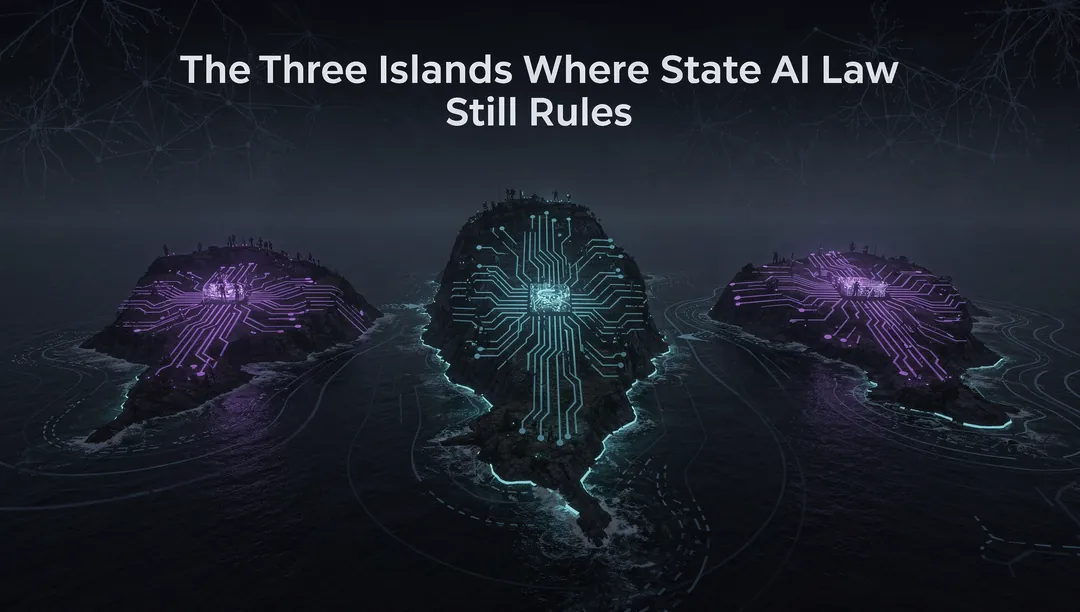
The most absurd thing about America's AI regulatory landscape in 2026 isn't that we have too many rules or too few—it's that the rules that matter most depend entirely on which patch of territory you're standing on. The executive order carving out three exemptions from federal preemption has created a strange archipelago: three islands where state AI law continues to wield power while the surrounding sea falls under federal jurisdiction. For any company operating in child safety, compute infrastructure, or government procurement, the message is unmistakable—don't pack away your state compliance teams just yet.
The Preemption Bargain
The logic behind federal preemption is straightforward enough. A patchwork of fifty different AI regulatory regimes stifles innovation, creates compliance nightmares, and leaves companies guessing which state's rules apply when algorithms cross borders. The executive order establishes a unified federal framework that supersedes this patchwork—except it doesn't. Three specific domains remain exempt from preemption, and understanding why reveals a great deal about where political consensus breaks down and where it holds firm.
The exemptions aren't random. They reflect areas where states have already built enforcement infrastructure, where local control is politically untouchable, or where the federal government simply lacks the appetite to override local preferences. Each island tells a different story about the tensions shaping AI governance.
Island One: Child Safety in AI Contexts
If there's one area where states refuse to cede ground, it's the protection of minors. The exemption for child safety in AI contexts means state attorneys general retain their power to enforce existing and future laws governing how AI systems interact with children—from chatbot design to content recommendation algorithms.
This exemption exists because child safety is political kryptonite. No federal administration wants to be seen as weakening state protections for kids, and any attempt to preempt those laws would face fierce opposition from both parties. States like California and New York have already enacted robust child digital safety statutes, and those laws now sit firmly beyond federal reach.
But the exemption creates a genuine compliance challenge. A social media company deploying AI-powered recommendation engines must still navigate varying state definitions of what constitutes a "child-directed" system, what parental consent mechanisms are required, and what data retention limits apply. The federal framework offers no shelter here—state law remains the final word.
From an AI perspective, this fragmentation is particularly painful. Training data policies, age-verification protocols, and content filtering standards all vary by state. Companies must essentially maintain parallel compliance architectures: one for the federal baseline, and another for each state with child safety laws on the books.
Island Two: AI Compute and Data Center Infrastructure
The second exemption covers AI compute and data center infrastructure—a domain where state power is deeply intertwined with economic incentives and physical geography. States have spent years competing to attract data center investment through tax breaks, energy subsidies, and streamlined permitting. The preemption exemption ensures they retain control over the regulatory environment governing these facilities.
This isn't just about zoning permits and power grid connections, though those matter enormously. States regulate the energy sources powering data centers, the environmental impact assessments required for construction, and the labor standards applicable to facility operations. When Virginia hosts the largest concentration of data centers in the world, or when Texas offers sweetheart energy deals to attract AI infrastructure, those are state-level policy choices that the executive order deliberately leaves intact.
The reasoning is pragmatic. Data centers are physical assets rooted in specific locations. Federal preemption of state infrastructure rules would create a constitutional showdown over states' traditional police powers—and the administration clearly decided that fight wasn't worth picking. For companies building or operating compute infrastructure, this means continued engagement with state legislatures, utility commissions, and environmental regulators.
Island Three: State Government Procurement of AI Systems
The third exemption is perhaps the most telling. State government procurement of AI systems remains outside federal preemption, meaning states can set their own terms for how they buy and deploy AI tools.
This exemption reflects a fundamental principle: the government as buyer retains discretion over what it purchases and under what conditions. States have been experimenting with procurement frameworks that require algorithmic impact assessments, bias audits, and transparency provisions before AI systems can be deployed in public services. Those experiments now continue unhindered.
The practical impact is significant. Any AI vendor selling to state agencies—from predictive policing tools to benefits eligibility systems—must comply with state-specific procurement standards. A company that clears the federal bar for responsible AI development may still find itself excluded from state contracts if it fails to meet additional requirements imposed by individual states.
For smaller AI companies seeking government contracts, this creates a dual compliance burden. They must satisfy both the federal framework's general requirements and whatever procurement-specific standards each target state has enacted. The cost of navigating this complexity can be prohibitive, potentially concentrating state procurement among larger vendors with the legal resources to manage multi-state compliance.
Why These Three—and Not Others?
The pattern is revealing. What unites these three domains is that they involve either politically sensitive constituencies (children), constitutionally protected state powers (infrastructure and procurement), or both. The federal government chose to preempt where it could—primarily commercial AI deployment and interstate commerce—while leaving untouched the areas where state authority is most deeply entrenched or most fiercely defended.
This isn't a clean ideological split. Child safety exemptions protect a progressive priority, while infrastructure and procurement exemptions preserve conservative principles of state autonomy. The executive order's carve-outs reflect political calculus, not regulatory philosophy.
Key Takeaways
Three exemption domains remain under state enforcement: child safety in AI contexts, AI compute and data center infrastructure, and state government procurement of AI systems. Companies operating in these areas face continued multi-state compliance obligations.
Child safety is politically untouchable: States retain full authority to regulate AI's interaction with minors, and the federal framework explicitly preserves this power. No administration will risk appearing to weaken protections for children.
Physical infrastructure stays local: Data centers are rooted in place, and states retain control over the energy, environmental, and permitting regimes that govern them. Federal preemption stops at the server farm door.
Procurement is the hidden battleground: State AI procurement standards create a parallel compliance regime that can exclude vendors who meet federal standards but fail state-specific requirements.
Fragmentation persists by design: The exemptions aren't loopholes—they're deliberate concessions to political reality. The patchwork problem isn't solved; it's just confined to three domains.
Conclusion
The executive order's three exemptions reveal an uncomfortable truth about AI governance in 2026: federal preemption is a compromise, not a solution. The islands where state law still rules aren't temporary holdouts awaiting future federal action—they're permanent features of the regulatory landscape, reflecting deep structural tensions between national uniformity and local control.
For AI companies, the message is clear. Compliance isn't getting simpler; it's getting more complex in specific, unpredictable ways. The federal baseline provides a floor, but in child safety, infrastructure, and procurement, state law remains the ceiling. Organizations that treat these exemptions as footnotes rather than foundational design constraints will find themselves scrambling to catch up.
If the current trajectory holds, these three islands may not remain isolated forever. As states push further—enforcing stricter child safety standards, imposing tougher environmental requirements on data centers, demanding more rigorous procurement audits—the pressure for broader federal action will grow. But until that day comes, the smart money bets on building compliance architectures flexible enough to handle both federal mandates and state-specific overlays. The regulatory sea level is rising, but these three islands aren't sinking anytime soon.
Key Takeaways:
The regulatory landscape for AI is shifting from reactive to proactive — Governments worldwide are no longer waiting for harm to occur before drafting rules. The first half of 2026 has seen a marked acceleration in legislative proposals aimed at governing AI development before it becomes ungovernable.
Corporate self-regulation remains insufficient — Despite numerous pledges and voluntary frameworks, the track record shows that market incentives alone do not reliably produce safety outcomes. External enforcement mechanisms are increasingly recognized as necessary complements to internal governance.
The global governance patchwork creates both risks and opportunities — Divergent regulatory approaches across jurisdictions create compliance challenges for developers, but they also provide natural experiments from which best practices can emerge.
Stakeholder representation in AI governance remains uneven — The communities most likely to be harmed by AI systems continue to have the least voice in how those systems are designed and deployed. This democratic deficit undermines both the legitimacy and effectiveness of current governance models.
Technical solutions and policy solutions must evolve in tandem — Neither algorithmic auditing requirements nor transparency mandates can succeed without corresponding advances in the tools and methodologies needed to implement them.
Conclusion:
The central challenge of mid-2026 is not a lack of awareness about AI risks, but a deficit of institutional capacity and political will to address them at the pace the technology demands. The window for shaping AI's trajectory toward broadly beneficial outcomes remains open, though it is narrowing.
If current trends continue — with regulation trailing deployment by years and enforcement trailing regulation by even more — we risk constructing a future where the most consequential decisions affecting human welfare are made by systems subject to minimal democratic accountability. That is not a future we should accept passively.
The path forward requires specificity over slogans. It demands concrete mechanisms: mandatory impact assessments before high-risk deployments, independent audit bodies with real enforcement teeth, and structured pathways for affected communities to seek redress. The technology itself is neutral; the governance we build around it will determine whether it serves the many or merely the few.
What we decide in the coming months will echo for decades. Let those decisions be deliberate, inclusive, and bold enough to match the moment.