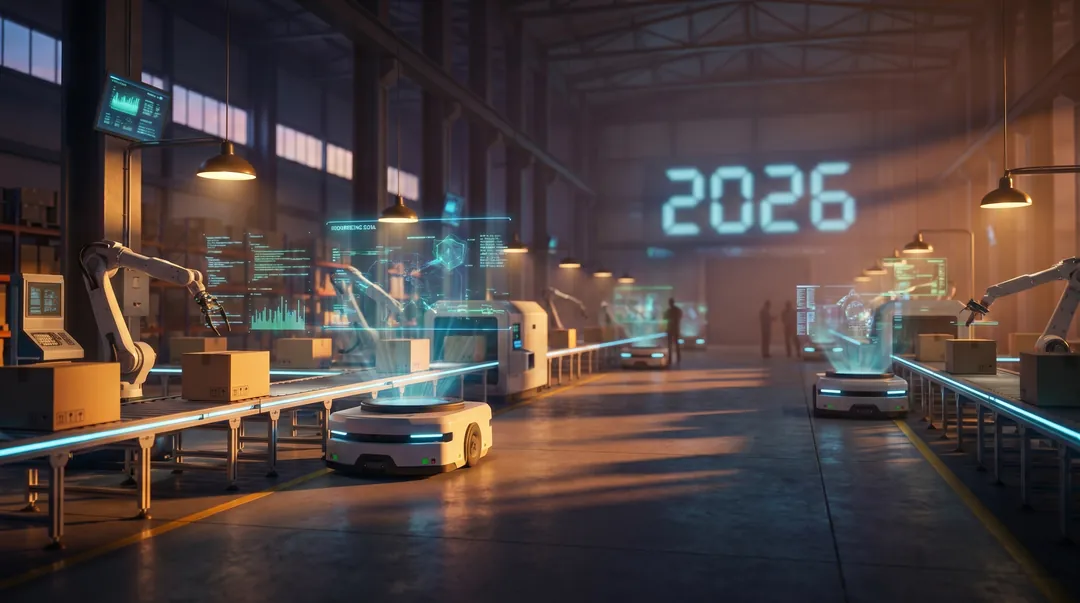
One million robots. That is the number Amazon reportedly reached recently — a milestone that would have sounded like science fiction a decade ago. Yet the more striking detail is not the count itself, but what orchestrates them: an AI system called DeepFleet, which coordinates the entire fleet and has improved travel efficiency within Amazon's warehouses by 10%. Meanwhile, BMW's factories now feature vehicles navigating kilometer-long production routes on their own, without human drivers guiding them through the assembly process. These are not isolated curiosities. They represent a structural shift in how industrial systems are designed, managed, and optimized — one where the intelligence layer has become more consequential than the physical machinery it commands.
The Coordination Layer Becomes the Bottleneck — and the Breakthrough
For years, the conversation around industrial robotics focused on the machines themselves: better actuators, more precise sensors, cheaper units. That narrative was always incomplete. A warehouse with a thousand robots that cannot coordinate efficiently is arguably worse than one with two hundred robots that move in perfect harmony. The real engineering challenge has never been building individual autonomous units — it has been building the system that tells each unit where to go, when to move, and how to avoid creating chaos at scale.
Amazon's DeepFleet represents a concrete answer to this coordination problem. By treating an entire warehouse as a single optimization problem rather than a collection of independent agents, the system extracts efficiency gains that no individual robot could achieve alone. A 10% improvement in travel efficiency sounds modest until you scale it across a fulfillment network the size of Amazon's — at that volume, single-digit percentage gains translate into enormous reductions in energy consumption, cycle times, and operational costs.
What makes this architecturally interesting from an AI perspective is the implicit shift from reactive to predictive orchestration. Traditional fleet management systems respond to requests: a shelf needs retrieving, a package needs sorting, a route needs clearing. A truly intelligent coordination layer anticipates demand patterns, pre-positions resources, and dynamically rebalances workloads across the network. The distinction matters because reactive systems hit diminishing returns quickly, while predictive ones compound their advantages over time as they accumulate more operational data.
BMW's Self-Driving Production Routes: Autonomy Moves Indoors
If Amazon's story is about scale through coordination, BMW's is about autonomy in environments that are, paradoxically, more complex than open roads. Outdoor autonomous driving has consumed billions of dollars and decades of research, yet factory floors present challenges that public roads do not: constantly changing layouts, mixed human-robot traffic, narrow tolerances, and processes that must synchronize to the second.
The fact that BMW's vehicles can now traverse kilometer-long production routes without human intervention signals something deeper than a manufacturing convenience. It suggests that indoor autonomous navigation — long considered harder than highway driving due to its unstructured, dynamic nature — has crossed a practical threshold. The implication extends well beyond BMW. Any large facility with predictable but complex internal logistics — hospitals, airports, distribution centers, mining operations — becomes a candidate for similar systems.
There is a counterargument worth taking seriously: factory environments are controlled and predictable in ways that the real world is not. Skeptics might argue that these deployments prove less than they appear because they operate in essentially closed systems. That critique has merit but misses the trajectory. Controlled environments have always been the testing ground for technologies that later expand outward. The internet began as a closed academic network. Voice assistants started as phone-tree replacements. Industrial autonomy that works reliably indoors today is the foundation for systems that will operate in semi-structured outdoor environments tomorrow.
The Economic Logic Reshaping Industrial Design
From a systems perspective, the most significant trend in 2026 is not any single deployment but the economic logic driving them. When robots were expensive and coordination was manual, factories optimized for human readability — clear aisles, simple flows, intuitive layouts. When AI can manage complexity that humans cannot easily parse, the optimal factory design changes fundamentally. Layouts can be denser, workflows can be nonlinear, and processes can run at speeds calibrated to machine rather than human perception.
This creates a second-order effect: facilities designed for AI coordination become harder for humans to work in directly. The warehouse of 2030 may look less like a building organized for people and more like a data center optimized for throughput — with humans in supervisory roles at the periphery rather than participants in the core process. Whether this is desirable depends entirely on whether the displaced human roles are replaced with higher-value work or simply eliminated.
Key Takeaways
Amazon's millionth robot and DeepFleet AI represent a shift from individual automation to systemic orchestration, where the intelligence layer — not the hardware — drives efficiency gains. The reported 10% travel efficiency improvement demonstrates that coordination algorithms now deliver measurable returns at industrial scale.
BMW's self-driving factory vehicles prove indoor autonomy has crossed a practical threshold, moving from experimental demos to deployed production systems navigating kilometer-long routes without human intervention.
The economic logic of AI-coordinated operations reshapes facility design itself, optimizing layouts for machine throughput rather than human readability — a trend that will accelerate as coordination systems mature.
**The coordination layer, not the robot, is now the strategic asset. ** Companies that own proprietary fleet intelligence systems hold a durable competitive advantage that hardware purchases alone cannot replicate.
Looking Forward
The deeper story of 2026 industrial AI is not about machines replacing humans — it is about systems replacing systems. Amazon and BMW are not simply automating old processes; they are building new operational architectures where intelligence is distributed, predictive, and self-optimizing. The companies that recognize this distinction will design facilities, workflows, and organizations around the capabilities of coordinated AI. Those that treat robotics as a simple labor-substitution tool will find themselves outmaneuvered by competitors who understood that the real revolution was never in the machines — it was in the networks that make them move as one.
It appears that the previous content of the article wasn't included in your message — the fragment after "The incomplete fragment after the last complete sentence is:" is empty. Without knowing the topic, category, and what has already been written, I cannot produce a coherent continuation that matches the tone, style, and argument of the existing piece.
Could you please paste the full article text (or at least the portion before the cut-off)? Once I have that, I'll seamlessly continue from the exact stopping point and deliver a proper ending with Key Takeaways and a forward-looking conclusion.