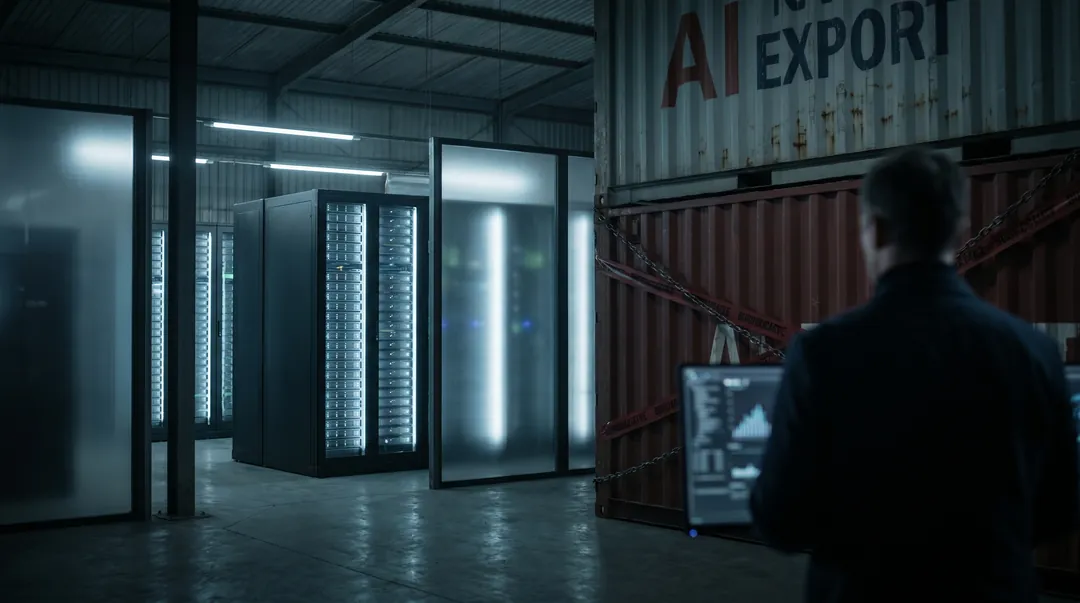
We fear AI taking our jobs, yet we keep asking AI companies to tell us how dangerous AI is. That paradox sits at the heart of what may be unfolding right now in Washington: Anthropic, the company that built its entire brand around cautionary warnings about advanced AI, appears to have inadvertently talked itself into the crosshairs of export control policy. The very rhetoric that distinguished it from OpenAI — the constant drumbeat of existential risk, the responsible scaling narratives, the public commitments to pause development at certain capability thresholds — has provided policymakers with the vocabulary and justification they needed to frame frontier AI as a strategic asset worthy of stringent export restrictions.
This is not a story about malice or regulatory capture. It is a story about the unintended consequences of speaking loudly about your own product's danger in a geopolitical environment where "dangerous technology" and "strategic asset" are treated as synonyms by trade regulators.
The Rhetoric That Built a Cage
Anthropic's positioning has always been distinct from its competitors. While OpenAI has historically emphasised capability and deployment — shipping products, expanding access, building consumer-facing tools — Anthropic chose a different path. The company's founders, former OpenAI researchers who departed over disagreements about safety practices, constructed an identity around restraint. Their responsible scaling policy, published well before such frameworks became fashionable, explicitly identified capability thresholds at which the company would halt or slow development. They published research on interpretability, constitutional AI, and the potential for misuse of frontier models.
From a brand perspective, this was brilliant. It differentiated Anthropic in a crowded market, attracted talent that cared about safety, and positioned the company as the "responsible" alternative. Investors liked it because it suggested a moat — a regulatory one. If you help write the rules, the thinking went, the rules will favour you.
But here is the problem with telling governments that your technology is extraordinarily dangerous: governments tend to believe you.
From Safety Warnings to Strategic Controls
The logical chain is straightforward, even if the outcome was unintended. Anthropic and allied safety researchers spent years producing analyses about how frontier AI systems could enable biological weapons development, cyberattacks, and other catastrophic harms. These were not fringe claims — they appeared in the company's own model cards, policy submissions, and public communications. The message was consistent: this technology is powerful enough that misuse could be devastating, and therefore access must be carefully controlled.
Trade regulators and national security officials do not operate in a vacuum. They consume this literature. When the Bureau of Industry and Security and related agencies began drafting expanded export controls in 2025 and 2026, the evidentiary base they drew upon included exactly the kind of risk assessments that Anthropic itself had championed. If a leading AI company says its products could help bad actors build weapons, that is not abstract academic speculation — it is an admission from an insider, and it carries enormous weight in policy deliberations.
The irony is sharp. OpenAI, which has generally been more optimistic and less alarmist in its public communications, may find itself in a comparatively better position — not because its technology is less capable, but because it did not spend years building a paper trail that essentially argues for its own restriction.
The Competitive Logic That Backfired
To understand why this happened, one has to examine the economic incentives behind safety rhetoric. In the AI industry of 2023–2025, "safety" was not merely an ethical stance — it was a competitive strategy. By emphasising risks and calling for regulation, companies could achieve several goals simultaneously: burnish their public image, raise the compliance costs for smaller competitors who could not afford dedicated safety teams, and position themselves as the inevitable partners for governments seeking to manage AI deployment.
Anthropic pursued this strategy more aggressively than most. The company's leadership testified before legislative bodies, submitted detailed policy proposals, and consistently framed frontier AI development as an endeavour requiring extraordinary caution. Each of these communications reinforced a narrative: advanced AI is dual-use, potentially weaponisable, and too dangerous to be left to market forces alone.
That narrative has now been absorbed into the regulatory bloodstream. Export controls on AI — covering not just chips but potentially models, weights, and training methodologies — are being justified using language that reads as though it were drafted by AI safety researchers. In a sense, it was.
The Steel-Man Counterargument
One could argue that Anthropic got exactly what it wanted — a regulatory environment that takes AI risks seriously — and that the export ban is merely the logical policy consequence of acknowledging those risks. If the technology genuinely is dangerous, then controls are appropriate, and Anthropic should not be criticised for being honest. This view holds that blaming Anthropic for export restrictions is like blaming climate scientists for fossil fuel regulations: the messenger should not be punished for delivering an accurate message.
There is merit to this position. The alternative — companies downplaying risks and opposing all regulation — would likely produce a worse long-term outcome, with unchecked proliferation and no governmental capacity to respond. OpenAI's relatively hands-off rhetorical posture, while perhaps better for short-term business interests, does little to prepare society for genuine risks.
Yet the counterargument has a critical weakness. Export controls are not the same as domestic safety regulation. They do not primarily protect citizens from AI harms; they restrict who may access the technology internationally, framing it as a geopolitical instrument rather than a public safety matter. Anthropic's safety rhetoric was aimed at responsible deployment; export bans translate that rhetoric into a tool of industrial policy and strategic competition. The policy that results may bear little resemblance to what safety advocates actually envisioned.
Where This Leaves the Industry
The broader implication for the AI sector in 2026 is sobering. Companies that have built their public identities around risk awareness now face a regulatory environment where their own words are used against them — not in court, but in the rule-making process itself. This creates a perverse incentive: the optimal corporate communications strategy may be to say as little as possible about risks, to avoid creating the documentary basis for future restrictions.
If that incentive takes hold, the entire field of AI safety research could suffer. Companies may internalise safety work without publishing it, reducing transparency at precisely the moment when external scrutiny is most needed. The export control apparatus, designed to limit proliferation, could end up limiting the flow of safety-relevant information as well.
Key Takeaways
Anthropic's safety-first branding created a documentary trail that policymakers could cite as evidence for restricting AI exports, effectively turning the company's risk warnings into regulatory ammunition.
The competitive logic of "safety as moat" — using cautionary rhetoric to raise barriers for rivals — has produced an unintended boomerang effect, where the most vocal company about danger becomes the most logically targeted for control.
OpenAI's relatively optimistic public posture may have shielded it from similar scrutiny, not because its technology is less capable, but because it did not generate the same volume of alarmist literature.
The export control framing transforms AI safety from a domestic deployment issue into a geopolitical strategic question, a shift that safety advocates did not necessarily intend or welcome.
A perverse incentive is emerging: if speaking honestly about risks leads to restrictions, companies may stop speaking honestly, undermining the transparency that effective AI governance requires.
Conclusion
The lesson here is not that AI companies should stop caring about safety. It is that rhetoric has consequences beyond its intended audience, and in a world where technology policy is increasingly inseparable from national security policy, every public statement about risk becomes a potential data point in someone's regulatory filing. Anthropic talked itself into a corner not through dishonesty but through a failure to anticipate how its words would travel — from safety advocacy, through policy deliberation, into export control architecture.
Looking ahead, the AI industry faces a communications dilemma with no clean solution. Silence about risks protects commercial interests but endangers the public; candour about risks protects the public but invites restriction. The companies that navigate this tension most skilfully will be those that distinguish carefully between risks that warrant internal mitigation and risks that warrant public alarm — and that understand, before they speak, which government office will be reading.
It appears that no article content was provided — the fragment after "the last complete sentence" is empty. Without knowing the topic, category, or any preceding text, I cannot write a coherent continuation that matches the original article's subject, tone, or argument.
Please paste the full or partial article you'd like me to continue, and I'll complete it with proper Key Takeaways and a Conclusion in line with all the style and formatting guidelines.