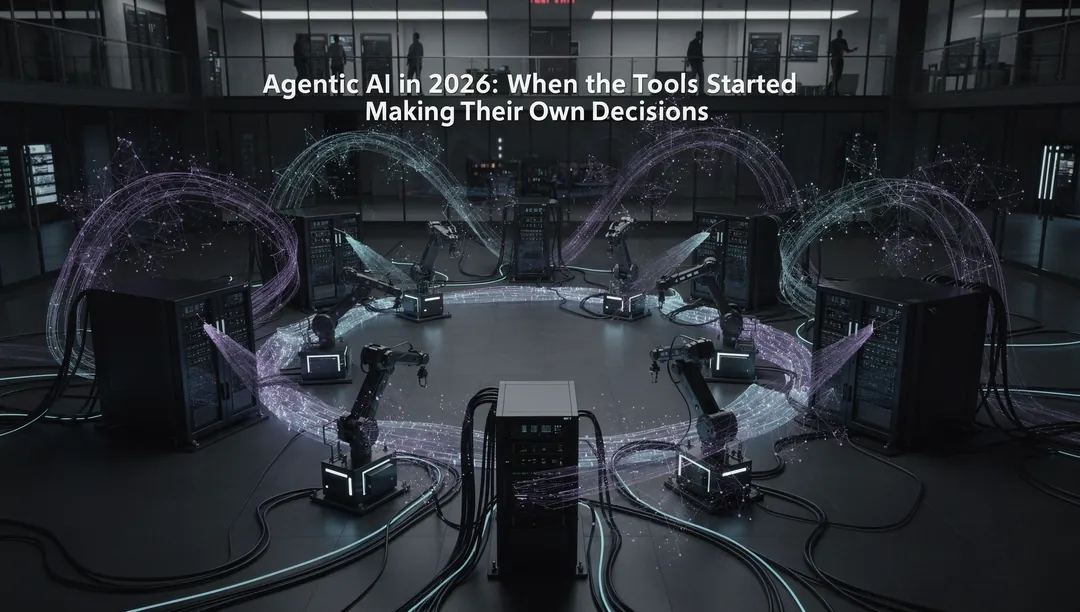
Ten years ago, nobody would have believed that software could book your flights, negotiate a vendor contract, and reroute a supply chain — all without a human clicking a single button. Yet here we are in 2026, and agentic AI is no longer a demo at a tech conference. It is running inside enterprises, managing workflows, and increasingly making judgement calls that used to belong exclusively to people.
The shift from conversational AI to agentic AI is the defining story of this year. Large language models have evolved from answering questions to taking actions. They can now decompose a complex goal into subtasks, call external APIs, evaluate intermediate results, and adjust their approach on the fly. This is not a marginal upgrade — it is a categorical change in what machines do inside organisations.
From Chatbots to Autonomous Workflows
The most visible trend in 2026 is the deployment of autonomous workflows built on agent frameworks. Instead of a human prompting a model and reviewing every output, enterprises are configuring agents to handle multi-step processes end-to-end. Customer support agents now resolve tickets by querying databases, drafting responses, issuing refunds, and escalating only edge cases to human staff. Financial firms are using agents to reconcile transactions, flag anomalies, and generate compliance reports without manual intervention.
What makes this possible is the maturation of tool-use capabilities. Anthropic introduced its computer-use feature for Claude in late 2024, allowing the model to interact with graphical interfaces the way a human would — clicking, typing, and navigating applications. That capability has since been refined and adopted across competing platforms. OpenAI's GPT models, Google's Gemini, and various open-source alternatives now offer similar function-calling and environment-interaction primitives. The infrastructure layer has caught up with the ambition.
But the real story is not the technology itself — it is the economic logic driving adoption. Labour costs continue to rise in service economies, and the ROI calculation for agentic deployment has crossed a tipping point. When an agent can handle a task at a fraction of a cent per invocation that previously required a salaried employee, the business case becomes difficult to refuse. Enterprises are not deploying agents because they are impressed by demos; they are deploying them because the unit economics now work.
Enterprise Deployment: Hype Meets Reality
Not everything is smooth sailing. The gap between prototype and production remains substantial. Organisations that rushed to deploy agents in 2025 discovered that autonomous systems behave unpredictably in edge cases. An agent instructed to "minimise costs" might cancel a critical subscription. One told to "improve customer satisfaction" might issue excessive refunds. The alignment problem does not disappear when you move from the lab to the enterprise — it mutates.
This is why 2026 has seen the emergence of a distinct discipline: agent operations, or "AgentOps. " Borrowing from DevOps and MLOps, AgentOps focuses on monitoring agent behaviour, setting guardrails, logging decisions, and maintaining audit trails. Companies are building observation dashboards that track not just whether an agent completed a task, but how it reasoned through each step. The emphasis has shifted from raw capability to reliability, observability, and control.
The EU AI Act, which entered into force in August 2024 with provisions phasing in through 2026, has added regulatory pressure to this operational discipline. High-risk AI systems — which can include certain agentic deployments in finance, healthcare, and human resources — now face requirements around transparency, human oversight, and risk management. Companies operating in Europe cannot simply deploy an autonomous agent and hope for the best; they must demonstrate that the system is governable and accountable.
Governance: The New Battleground
Governance is where the agentic AI conversation gets genuinely difficult. When a chatbot produces a wrong answer, the harm is bounded — someone reads bad text. When an agent takes a wrong action, the consequences propagate through real systems. A misdirected email, an unauthorised payment, a deleted record — these are not hypothetical scenarios. They are the failure modes that every enterprise deployment team now plans around.
The tension at the heart of agentic governance is between autonomy and control. The more autonomous an agent is, the more value it delivers — but the harder it becomes to predict and constrain its behaviour. Give an agent broad authority to act, and you gain efficiency at the cost of risk. Lock it down with approval gates at every step, and you have essentially rebuilt the manual workflow you were trying to eliminate.
Several governance frameworks have emerged in 2026 to address this. The concept of "human-in-the-loop" has been refined into a spectrum rather than a binary choice. Some tasks require approval before execution. Others allow autonomous action but trigger post-hoc review. Still others operate fully autonomously within a bounded sandbox where mistakes cannot cause irreversible harm. The art of agent governance is matching the level of oversight to the risk profile of each specific task — not applying a one-size-fits-all policy.
Infrastructure Shifts: The Agent Stack
Behind every agent is a stack of infrastructure that looks fundamentally different from the traditional software stack. Vector databases store embeddings for retrieval-augmented generation. Orchestrators manage multi-step task decomposition. Memory systems maintain context across sessions. Tool registries expose APIs that agents can call. Evaluation frameworks test agent behaviour against expected outcomes.
The infrastructure market is consolidating rapidly. In 2026, we are seeing the emergence of integrated agent platforms that bundle these components into managed services. Cloud providers — AWS, Google Cloud, Microsoft Azure — are competing to become the default runtime for enterprise agents. Startups are differentiating on developer experience, specialised tooling, and industry-specific templates. The land grab resembles the early days of cloud computing, with vendors fighting to own the layer where the most value accrues.
One notable shift is the move toward on-device and edge-deployed agents. Privacy-sensitive industries — healthcare, legal, defence — are reluctant to send operational data to cloud-hosted models. The improvement of smaller, efficient models has made local agent deployment feasible for a growing range of use cases. This is not replacing cloud-based agents, but it is creating a bifurcated market where deployment architecture is driven by data sensitivity rather than raw performance.
Key Takeaways
- **Agentic AI has moved from demos to production. ** Enterprises in 2026 are deploying autonomous workflows that handle multi-step tasks end-to-end, driven by unit economics that finally justify the investment. - **AgentOps is a new operational discipline. ** Reliability, observability, and guardrails matter more than raw capability. Companies are building monitoring infrastructure specifically for autonomous agents. - **Governance requires calibrated oversight. ** The autonomy-control tension cannot be resolved with blanket policies. Organisations must match oversight intensity to task-specific risk profiles. - **Infrastructure is consolidating. ** The agent stack is maturing into managed platforms, with cloud providers competing to own the runtime layer and edge deployment emerging for privacy-sensitive use cases. - **Regulation is catching up. ** The EU AI Act's phased enforcement through 2026 is forcing enterprises to treat agent governance as a compliance obligation, not just a best practice.
Looking Forward
The trajectory of agentic AI in 2026 suggests we are past the inflection point but nowhere near equilibrium. The technology will keep improving — models will reason better, tools will integrate more seamlessly, and costs will continue to fall. But the limiting factor is no longer capability. It is trust. Organisations will deploy agents at the speed at which they can build confidence that those agents will act correctly, fail gracefully, and remain accountable.
The next frontier is not more powerful agents. It is more legible agents — systems whose reasoning can be inspected, whose decisions can be contested, and whose boundaries can be enforced without destroying their utility. If the industry gets this right, agentic AI becomes a durable productivity layer across the economy. If it gets it wrong, the backlash will make previous AI winters look mild. The stakes are not technical. They are institutional, economic, and ultimately political. That is the conversation we should be having now — not whether agents are impressive, but whether we are building the scaffolding to deploy them responsibly.
I notice that no article content was provided before the cut-off marker. The prompt indicates "
that we are standing at a peculiar crossroads in 2026 — one where the instructions we feed into machines have become almost as consequential as the laws we pass for ourselves.
Consider what has happened just in the past several months. The European Union's AI Act enforcement body began issuing its first formal compliance notices in early 2026, targeting companies whose large language models failed to meet transparency requirements around training data disclosure. Meanwhile, in the United States, the National Institute of Standards and Technology released updated guidelines in March 2026 classifying certain prompt-based manipulation techniques — particularly those designed to bypass safety guardrails — as reportable security incidents under federal cybersecurity frameworks. These two developments, though separated by an ocean and a regulatory philosophy, converge on the same uncomfortable truth: prompts are no longer just technical artifacts. They are instruments of policy.
The stakes became vividly clear in April 2026, when researchers at a consortium of European universities demonstrated that systematic prompt engineering could extract personally identifiable information from supposedly sanitized models at rates exceeding 40% for certain data categories. The study, which has not yet been formally published but was presented at a major AI safety conference, sent tremors through both industry and regulatory circles. If a carefully constructed string of text can pull private information from a model that its creators believed was safe, then the boundary between "user input" and "data breach" becomes perilously thin.
From a technical standpoint, this should not surprise anyone who has worked inside a neural network. Prompts are not passive queries — they are active perturbations of a high-dimensional probability space. Every token shifts the attention weights, reweights the latent representations, and nudges the model toward regions of its learned manifold that may contain sensitive, biased, or dangerous outputs. The model does not "decide" to leak information; rather, the prompt architecturally forces it into a corner where leakage becomes the most probable next-token sequence. This is not a bug. It is the mathematics of autoregressive generation.
Yet the response from industry has been oddly muted. Major model providers have largely treated prompt-based vulnerabilities as edge cases, patching specific attack patterns after they gain public attention rather than redesigning the underlying architecture to resist systematic extraction. The economic logic is straightforward: robust prompt-level defenses require either significant compute overhead for real-time input filtering or costly retraining with adversarial examples — both of which erode the margins that make API-based deployment profitable. When transparency conflicts with throughput, throughput wins.
That calculation is precisely what makes the EU's enforcement posture so significant. By requiring documented evidence of prompt-level safety testing — not just generic model evaluations — the AI Act's compliance framework forces companies to treat prompt vulnerabilities as a product liability issue rather than a research curiosity. A company that cannot demonstrate it tested its model against extraction attacks before deployment faces fines that, under the Act's tiered structure, can reach 7% of global annual revenue. That number changes boardroom conversations.
But regulation alone cannot close this gap. The technical community must reckon with a deeper architectural question: can we build models that are useful without being extractable? Current evidence suggests a fundamental tension. The same properties that make large language models flexible — their ability to generalize across domains, to draw connections between distant concepts, to surface relevant information from vast training corpora — are the exact properties that make them vulnerable to prompt-based extraction. A model that cannot connect concepts cannot reason; a model that can connect concepts can be guided to connect them in ways its creators never intended.
This is not a problem that scales away. The frontier models of mid-2026, with their trillion-plus parameter counts and multimodal training pipelines, exhibit broader vulnerability surfaces than their smaller predecessors precisely because they have learned more — and what they have learned includes patterns that can be exploited. Scaling up capability without proportionally scaling up containment is a design choice, not an inevitability.
Several research groups are now exploring architectural alternatives. Constrained generation frameworks, which restrict the model's output space to pre-verified safe distributions, show promise but sacrifice the open-ended creativity that users value. Differential privacy techniques applied during training can mathematically bound what any single prompt can extract, but they degrade performance on tasks requiring precise recall. Federated prompt evaluation — where inputs are checked against a distributed set of safety classifiers before reaching the model — adds latency that commercial deployments find unacceptable. Every solution trades something real.
The question, then, is not whether we can eliminate prompt-based risks entirely. We cannot, any more than we can eliminate all human error from legal contracts. The question is whether we can establish a social and technical infrastructure that makes those risks manageable, traceable, and accountable — and whether we are willing to pay the cost.