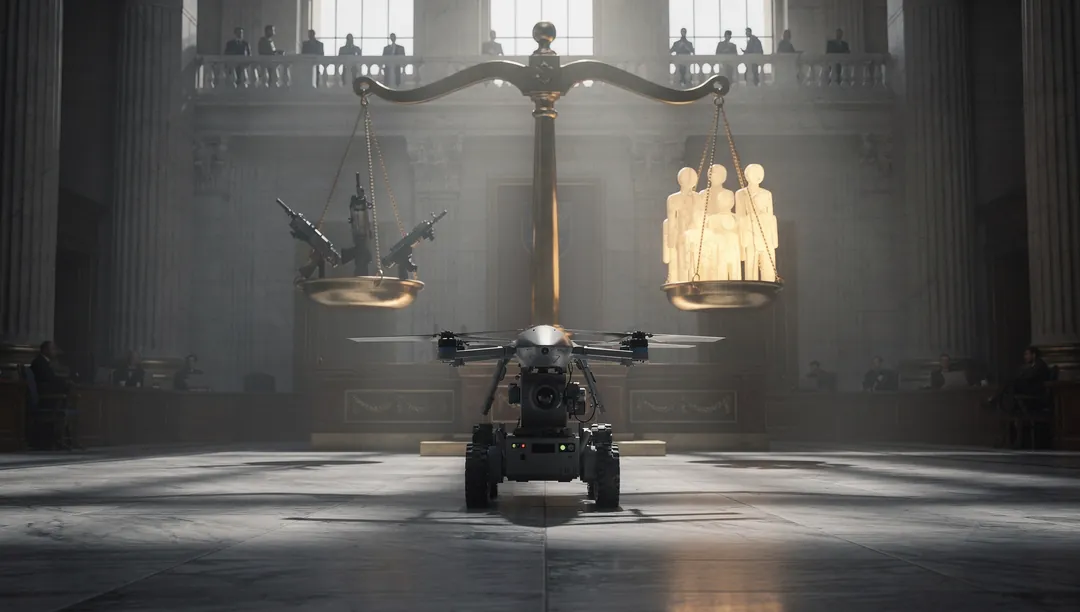
Imagine a battlefield where no human pulls the trigger. A drone identifies a target through thermal imaging, runs a classification algorithm, and fires— all within 200 milliseconds. There is no hesitation, no moral anguish, no soldier questioning whether the figure in the crosshairs is a combatant or a child carrying water. This is not science fiction. In 2026, several nations are actively developing and, in some cases, deploying Lethal Autonomous Weapons Systems (LAWS) that can select and engage targets without meaningful human intervention. The Belfer Center for Science and International Affairs at Harvard Kennedy School has contributed to the growing body of research arguing that such systems present a "promising alternative to ethical warfighting" by eliminating what it terms "errors inherent in human monotonic thinking"—the cognitive biases, fatigue, and emotional distortions that lead soldiers to commit atrocities. The claim is provocative: machines, unburdened by rage or fear, might wage war more ethically than humans ever could. But this argument demands far more scrutiny than it has received.
Who Stands to Gain—and Who Stands to Lose
The debate over LAWS involves at least three distinct stakeholder groups, each with fundamentally different interests. First, military institutions and defense contractors see autonomous weapons as a force multiplier—systems that never tire, never panic, and can process battlefield data faster than any human brain. For these actors, the ethical framing is secondary to strategic advantage. Second, civilian populations in conflict zones bear the existential risk of algorithmic error. A misidentified target is not a statistical anomaly to them; it is a funeral. Third, the international legal community faces the erosion of accountability frameworks built on the assumption that a human mind stands behind every lethal decision. The Geneva Conventions' principle of distinction—requiring combatants to distinguish between military objectives and civilians—was drafted with human judgment in mind, not neural networks.
The core value conflict is stark: military efficiency versus moral accountability. Proponents argue that removing human emotional volatility from combat decisions reduces civilian casualties; opponents counter that delegating life-and-death choices to machines severs the moral link between action and responsibility. A second tension runs deeper: technological determinism versus democratic control. If only a handful of nations possess advanced LAWS, they gain asymmetric power to project force without domestic political cost—no body bags, no public outcry, no congressional hearings. Warfare becomes easier to initiate and harder to constrain.
Why This Problem Persists: The Structural Logic of Automation
The persistence of the LAWS debate is not accidental. It reflects three reinforcing mechanisms. Economically, the defense industry operates on a "first-mover advantage" model: nations that develop and deploy autonomous systems early set technical standards and gain battlefield experience that latecomers cannot easily replicate. This creates a race dynamic where ethical caution is penalized as strategic vulnerability. Legally, existing international humanitarian law was designed for human combatants. The principle of "proportionality"—weighing military advantage against civilian harm—presupposes a capacity for moral reasoning that current AI systems do not possess. No treaty explicitly bans LAWS, and the UN Convention on Certain Conventional Weapons has discussed the issue for over a decade without reaching consensus, creating a regulatory vacuum that technological development fills by default. Technically, the "black box" problem of machine learning means that even developers cannot always explain why an autonomous system made a particular targeting decision. This opacity makes post-hoc accountability nearly impossible: when a drone kills the wrong person, who is responsible—the programmer, the commander who deployed it, the manufacturer, or the algorithm itself?
The Belfer Center's argument that autonomous systems eliminate "human monotonic thinking errors" contains a critical omission. Human cognition is indeed flawed—soldiers under stress make tragic mistakes. But human judgment also provides the capacity for mercy, for recognizing when rules should be overridden by compassion, for seeing the child in the uniform. Algorithms optimize for pattern matching, not for moral imagination. Replacing one kind of error with another is not ethical progress; it is merely a different category of failure.
A Clear Position and a Concrete Recommendation
The argument that machines can wage war more ethically than humans is seductive but fundamentally flawed. It conflates consistency with morality. An algorithm that reliably applies deadly force according to preset parameters is not "ethical" simply because it lacks malice; it is ethically vacant. Ethics requires the capacity to question one's own actions, to recognize moral ambiguity, to choose restraint when the rules permit violence. Current AI systems possess none of these capacities. Furthermore, the claim that autonomous weapons reduce civilian casualties remains empirically unproven; it is a theoretical assertion, not a demonstrated outcome. Until rigorous, independent battlefield data confirms this claim, it should be treated as marketing, not evidence.
The strongest counterargument—that human soldiers commit war crimes while machines do not—deserves serious engagement. Yes, human-perpetrated atrocities are well-documented. But this argument presents a false binary. The choice is not between flawed humans and flawless machines; it is between systems with known failure modes and systems with unknown ones. Human accountability, however imperfect, at least provides a mechanism for justice: soldiers can be court-martialed, commanders can be prosecuted. Algorithmic accountability remains a conceptual ghost.
Recommendation: The international community should negotiate a binding treaty mandating "meaningful human control" over all lethal targeting decisions. This treaty must define "meaningful control" not as a perfunctory approval step but as a genuine capacity for a human operator to override or abort an engagement in real time, with sufficient time and information to exercise moral judgment. The treaty should establish an independent verification body—modeled on the Organisation for the Prohibition of Chemical Weapons—with authority to inspect LAWS development programs and certify compliance. Without such a framework, the proliferation of autonomous weapons will proceed unchecked, and the moral consequences will be irreversible.
Key Takeaways
- The "ethical machine" argument is unproven: Claims that LAWS reduce civilian harm by eliminating human bias remain theoretical; no independent battlefield data currently substantiates this assertion. - Accountability is the irreducible problem: When an autonomous system makes a lethal error, existing legal frameworks cannot assign responsibility, creating a moral and legal vacuum. - The race dynamic rewards recklessness: Nations that prioritize ethical caution in LAWS development risk strategic disadvantage, incentivizing speed over safety. - Meaningful human control is non-negotiable: The capacity for real-time human override of lethal decisions must be preserved and legally mandated, not treated as an optional feature. - Regulatory vacuums enable proliferation: Over a decade of UN discussions on LAWS have produced no binding treaty, allowing development to outpace governance.
Conclusion
The Belfer Center's framing of autonomous weapons as a corrective to "human monotonic thinking errors" captures a genuine tension but resolves it too easily. Human soldiers are indeed fallible; they are also the only moral agents currently capable of exercising the judgment that international humanitarian law demands. Replacing them with algorithms that mimic consistency without understanding is not an ethical advancement—it is an abdication. If the international community fails to establish binding rules for meaningful human control over lethal autonomous systems, the next generation of conflicts will be fought by machines that kill without malice and without mercy. The question is not whether such weapons can be built; it is whether a civilization that builds them can still call itself civilized.