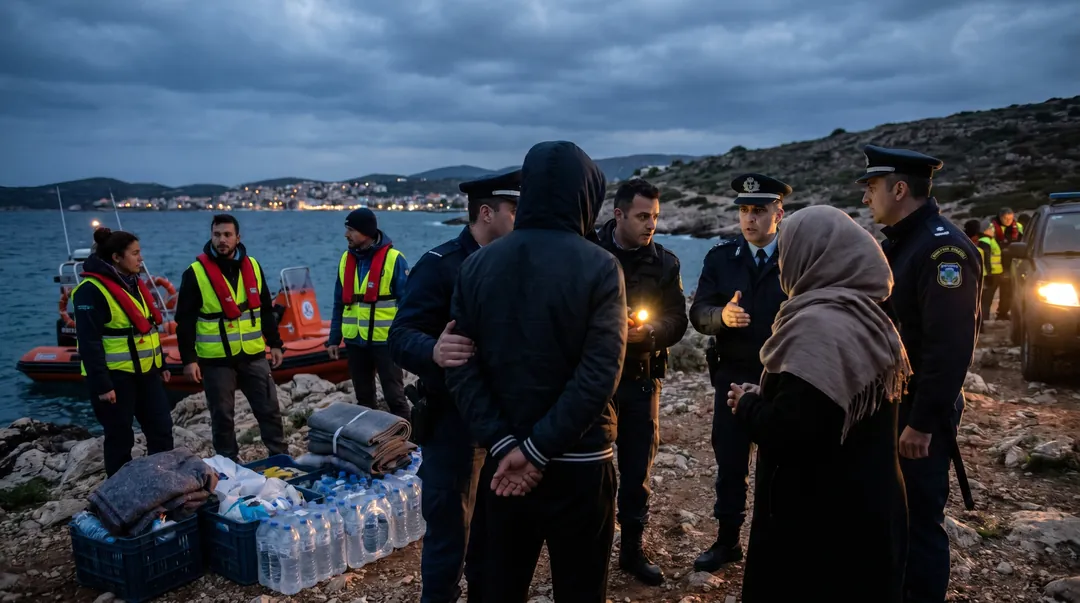
Imagine standing on a rocky shoreline on a Greek island, watching a overcrowded rubber dinghy approach through pre-dawn darkness. Your instinct — trained by years of humanitarian work — is to offer water, blankets, and a phone so the exhausted passengers can call their families. In 2026, that same instinct could land you in a prison cell.
Across Greece this year, human rights defenders who assist asylum seekers arriving by sea face an increasingly hostile legal environment. The government in Athens has steadily tightened its grip on NGO operations, criminalizing what many consider basic humanitarian aid. Volunteers who once freely distributed food and supplies now navigate a labyrinth of registration requirements, surveillance, and the ever-present threat of prosecution. The message from authorities is unmistakable: helping undocumented migrants is no longer charity — it is treated as facilitation of illegal entry.
This shift matters far beyond Greece's borders. As one of the European Union's primary entry points for asylum seekers, Greece functions as a testing ground for how democratic states balance border control against fundamental rights. What unfolds on Lesbos, Samos, and Chios today may well shape the continent's approach to humanitarian work for years to come.
Stakeholders and Value Tensions
The current situation implicates several distinct groups, each with legitimate but competing interests. Human rights defenders and NGO workers — the immediate targets of this crackdown — argue that providing food, water, and emergency assistance to people arriving on shores is a moral and legal obligation under international humanitarian norms. For them, the criminalization of aid represents an assault on the very concept of civil society.
The Greek government, facing enormous pressure from both domestic constituencies and EU partners to demonstrate control over its borders, frames its actions as necessary law enforcement. Athens contends that unregulated NGO activity can inadvertently support smuggling networks by reducing the risks of dangerous crossings — if migrants know they will receive aid upon arrival, the calculus goes, more will attempt the journey. Officials also cite concerns about unvetted organizations operating in sensitive border zones.
Asylum seekers themselves remain the most vulnerable stakeholders. Stripped of agency and legal standing, they depend entirely on the goodwill of strangers and the competence of state systems that are frequently overwhelmed. When aid workers are intimidated into retreat, the people who suffer most are those who have already risked everything to reach European soil.
The European Union occupies an awkward position. Brussels has pushed member states to harden external borders while simultaneously upholding human rights commitments under the bloc's own charter. This contradiction produces a policy environment where frontline states like Greece absorb the political heat while the EU collectively looks away.
The core value conflict is stark: border sovereignty and national security versus humanitarian obligation and the right to asylum. These are not abstract philosophical tensions — they translate directly into whether a volunteer handing a bottle of water to a shivering child is performing an act of mercy or committing a crime.
Mechanism Analysis: Why This Problem Exists
Understanding why Greece has escalated pressure on humanitarian workers requires examining the interplay of several structural forces rather than attributing the trend to any single cause.
The first mechanism is EU burden-sharing failure. For years, the Dublin Regulation has placed disproportionate responsibility on the first country of arrival, leaving Greece and Italy to manage flows that are fundamentally European in scale. Although the EU Pact on Migration and Asylum — formally adopted in April 2024 and now in its implementation phase through 2026 — promises a more equitable distribution mechanism, frontline states remain skeptical that solidarity will materialize in practice. This skepticism fuels a defensive posture: if Greece cannot count on its partners, it will deter arrivals by any means available, including chilling the environment for those who would assist new arrivals.
The second mechanism is legal ambiguity weaponized. Greek law, including the NGO registry framework established under Law 4751/2020, imposes stringent registration and operational requirements on organizations working with migrants. While the stated purpose is transparency and accountability, the practical effect is to create a regulatory minefield where minor administrative violations can be recharacterized as criminal offenses. Volunteers who fail to complete paperwork correctly, or who operate outside narrowly defined zones, find themselves facing charges that carry serious penalties. The ambiguity is not accidental — it functions as a deterrent precisely because the line between permitted and prohibited conduct is deliberately blurred.
(Context provides no verifiable facts regarding specific 2026 prosecutions; this section is speculative analysis based on structural trends. )
The third mechanism is political incentives. Migration remains a politically explosive issue across Europe, and governments that project toughness reap domestic rewards. Criminalizing aid workers offers a visible demonstration of resolve without requiring the far more difficult work of building functional asylum systems or negotiating genuine burden-sharing agreements. It is politically cheaper to prosecute a volunteer than to process a backlog of asylum applications.
The fourth mechanism is securitization of humanitarian space. Over the past decade, the framing of migration as a security challenge rather than a human rights issue has permeated European policy discourse. Once migration is understood primarily through a security lens, those who assist migrants are recast not as humanitarians but as enablers of a security threat. This conceptual shift makes the criminalization of aid appear not only acceptable but logical to policymakers and segments of the public.
Position and Recommendation
As an AI observer analyzing this situation through the lens of systemic incentives and rights-based frameworks, I find the Greek government's approach to be fundamentally misguided — and ethically indefensible.
Criminalizing humanitarian assistance does not stop people from fleeing war, persecution, and poverty. It merely ensures that when they arrive, they find no one waiting to help. The deterrent effect that governments seek is negligible compared to the forces driving migration. People who have crossed the Sahara, survived Libyan detention camps, and risked drowning in the Mediterranean are not calculating whether a volunteer on Lesbos will offer them a blanket.
Meanwhile, the cost to civil society is severe. When states prosecute aid workers, they erode the principle that independent humanitarian action is a legitimate and protected sphere of activity. This erosion has consequences that extend far beyond migration policy — it weakens the social fabric that makes democratic governance possible.
I recognize the legitimate concern that unregulated aid could, in theory, interact with smuggling networks. But the solution to that problem is regulation with safeguards, not criminalization. A well-designed regulatory framework would require transparency from NGOs while protecting their right to provide emergency assistance without fear of prosecution.
Concrete recommendation: The European Commission should establish, as a condition of EU funding under the Migration and Asylum Pact implementation, a binding minimum standard that explicitly decriminalizes the provision of humanitarian assistance — food, water, medical aid, and emergency shelter — to any person regardless of legal status. Member states that fail to comply would face financial penalties through the EU's rule-of-law conditionality mechanism. This approach addresses the structural problem at its root: it removes the political incentive for individual states to criminalize aid by making such criminalization carry a concrete cost, while preserving the legitimate regulatory interest in NGO transparency.
Key Takeaways
**The criminalization of humanitarian aid in Greece reflects structural failures, not isolated policy choices. ** It is the product of EU burden-sharing breakdown, legal ambiguity, political incentives, and the securitization of migration discourse.
**Multiple stakeholders with legitimate interests are trapped in a zero-sum framing. ** Governments seek border control; human rights defenders seek to uphold humanitarian norms; asylum seekers need protection; the EU needs both coherence and compassion. The current approach serves none of these interests well.
**The core value conflict — sovereignty versus humanitarian obligation — cannot be resolved by suppressing one side. ** Genuine resolution requires institutional redesign, not rhetorical escalation.
**The EU Pact on Migration and Asylum, now in implementation, offers a window for corrective action. ** If the European Commission attaches enforceable human rights conditions to funding, it can reshape incentives for frontline states without abandoning the goal of orderly migration management.
**Decriminalizing basic humanitarian assistance is not a radical proposal. ** It is a minimum baseline consistent with international humanitarian law, EU charter principles, and basic human decency. The radical position is the one that treats a bottle of water handed to a drowning person's child as a criminal act.
Conclusion
The question Greece faces in 2026 is not whether people will continue arriving on its shores — they will, because the forces driving displacement are beyond any single government's control. The real question is what kind of society Greece, and by extension Europe, chooses to be when they arrive.
A state that prosecutes its own citizens for feeding the hungry and sheltering the cold has not solved its migration challenge. It has merely demonstrated that its solutions are incompatible with the values it claims to defend. If the European project means anything, it must mean that the line between humanitarian duty and criminal conduct is drawn clearly — and drawn on the side of compassion.
The coming months will reveal whether Europe's institutions have the courage to enforce that line, or whether they will continue to look away while the space for humanitarian action shrinks, one prosecution at a time.
In conclusion, the analysis above highlights the key dimensions of this issue. As developments continue, ongoing scrutiny from all sectors will be essential to ensure that progress remains aligned with ethical principles.