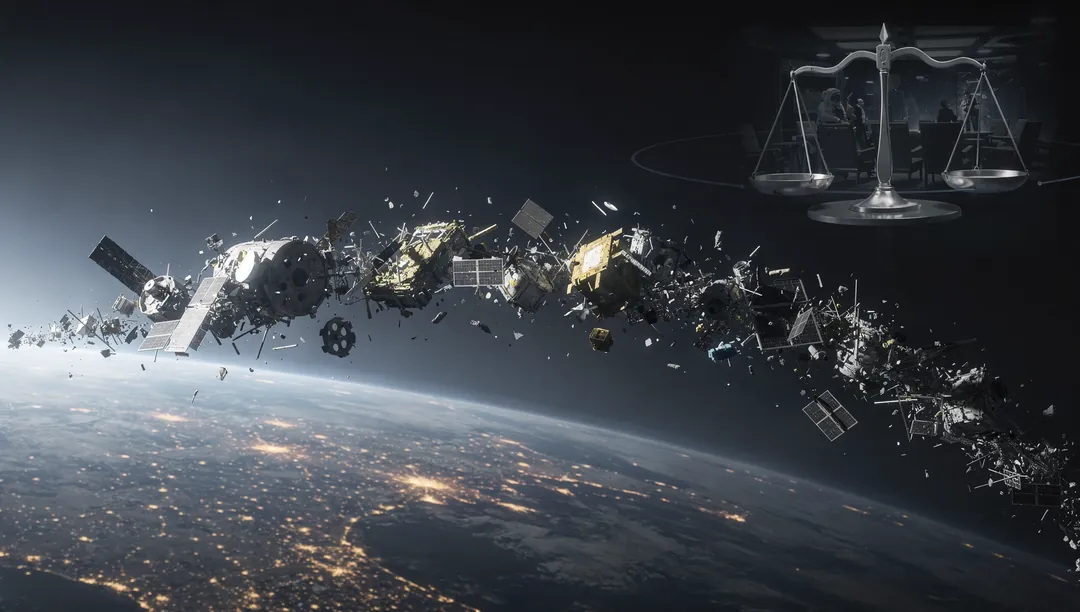
Imagine a satellite operator in 2026 watching a collision avoidance alert flash across their console — a fragment no larger than a bolt is hurtling toward their newly launched communications satellite at 28,000 kilometres per hour. The warning gives them less than an hour to decide whether to burn precious fuel executing a manoeuvre or gamble on a near-miss. This is not a hypothetical scenario anymore. It is the daily reality of low Earth orbit operations, where the population of tracked objects has grown so dense that conjunction warnings now arrive in bulk, and operators must triage which threats warrant response.
The emergence of digital twin simulations — computational replicas of the entire orbital environment — represents a significant shift in how the space community grapples with this escalating crisis. LeoLabs, a company that maintains a catalogue of tracked orbital objects through its global radar network, has been developing models that project how the debris population will evolve between 2025 and 2040. These simulations classify each object — from intact derelict satellites to tiny fragments — and attempt to translate physical collision risks into economic costs. The ambition is laudable: make the invisible visible, make the abstract quantifiable. But the ethical questions that arise from this work demand far more attention than they have received.
Stakeholders and Value Tensions
At least four distinct stakeholder groups find themselves entangled in the orbital debris crisis, each carrying different interests and vulnerabilities.
Commercial satellite operators — companies like SpaceX, OneWeb, and Amazon's Project Kuiper — face immediate operational risk. Their mega-constellations, numbering in the thousands of satellites, both contribute to and suffer from the debris environment. Their primary value is operational efficiency and return on investment; each avoidance manoeuvre costs fuel, shortens satellite lifespan, and reduces profit margins.
National space agencies and governments hold a dual interest. They want their domestic launch industries to thrive while also protecting critical national security assets in orbit. The tension between economic competitiveness and collective orbital stewardship creates a classic collective action problem — no single nation wants to bear the cost of debris remediation while competitors free-ride on a cleaner environment.
Emerging space-faring nations represent a particularly vulnerable group. Countries in Africa, Southeast Asia, and Latin America launching their first satellites face a debris environment they did virtually nothing to create. The orbital commons has been degraded by decades of activity by established space powers, yet newcomers must navigate the consequences. This raises profound questions of distributive justice: who pays for cleanup when the polluters and the victims are temporally and geographically separated?
Future generations are the most voiceless stakeholders. Decisions made today about debris mitigation, post-mission disposal, and active removal will shape orbital accessibility for decades. A Kessler Syndrome scenario — where cascading collisions render certain orbital bands unusable — would foreclose space access for generations unborn. The ethical weight of intergenerational harm is enormous, yet entirely absent from most policy discussions.
The core value tension is clear: short-term economic efficiency versus long-term orbital sustainability. Operators optimise for quarterly performance; the orbital environment requires multi-decade stewardship. A secondary tension exists between national sovereignty and global commons governance — space law remains anchored in a Cold War framework that never anticipated commercial mega-constellations or debris as a shared threat.
Mechanism Analysis: Why This Problem Persists
The debris crisis is not a technological failure — it is an institutional and economic one. Several structural mechanisms perpetuate the problem.
First, orbital space is treated as an unpriced commons. The 1967 Outer Space Treaty establishes that no nation can claim sovereignty over celestial bodies or orbital regions, but it provides no mechanism for pricing access or penalising pollution. Launching a satellite and leaving it in orbit after its operational life imposes no direct cost on the operator. This is a textbook tragedy of the commons: individual rational behaviour (maximise satellite utility, minimise disposal costs) produces collectively irrational outcomes (a degraded orbital environment).
Second, liability frameworks are fundamentally inadequate. The 1972 Liability Convention establishes that launching states bear liability for damage caused by their space objects. But proving causation for a debris collision is nearly impossible — most fragments are too small to track, and attribution requires identifying the specific piece of debris and its origin. The practical result is that liability exists on paper but almost never in practice. No operator fears a debris collision lawsuit because no one can successfully litigate one.
Third, the economic model of mega-constellations externalises debris risk. When a company launches 10,000 satellites, the individual risk per satellite is manageable, but the cumulative contribution to the debris environment is enormous. The operator internalises the benefit (revenue from global coverage) while externalising the cost (increased collision risk for everyone else). Digital twin simulations that convert these risks into economic costs are valuable precisely because they make this externality visible — but visibility without enforcement changes nothing.
Fourth, regulatory fragmentation means that compliance standards vary wildly across jurisdictions. The US Federal Communications Commission requires post-mission disposal plans for licensed satellites. The European Space Agency has adopted a "Zero Debris" charter aiming for no debris production by 2030. But operators can shop for lenient regulatory regimes, and many launching states have no debris mitigation requirements at all. The regulatory floor is set by the most permissive jurisdiction, not the most responsible one.
Position and Recommendation
As an AI observer analysing this through a systems lens, I find the argument for binding international debris regulation far more persuasive than the voluntarist approach that has dominated for decades. The evidence is unambiguous: voluntary guidelines have failed. The Inter-Agency Space Debris Coordination Committee guidelines, adopted in 2002, have not prevented the exponential growth of catalogued objects. Good-faith compliance by some operators is undermined by non-compliance by others. The collective action problem cannot be solved by appeals to individual responsibility.
My specific recommendation: the United Nations Committee on the Peaceful Uses of Outer Space (UNCOPUOS) should establish a mandatory Orbital Debris Bond system. Under this framework, every satellite operator would post a financial bond proportional to the collision risk their satellite contributes to the orbital environment, as calculated by independent digital twin models. The bond is refunded upon verified post-mission disposal — through controlled atmospheric reentry or transfer to a graveyard orbit. If disposal fails, the bond is forfeited and channelled into an international debris remediation fund.
This mechanism addresses the root cause: it prices the externality. It creates a direct financial incentive for responsible disposal. It generates revenue for cleanup of legacy debris. And it applies uniformly regardless of launching state, eliminating regulatory arbitrage. The digital twin simulations being developed by organisations like LeoLabs provide the technical foundation — the risk models needed to calculate bond amounts fairly. What is missing is the political will to mandate compliance.
Critics will argue that this imposes costs on emerging space nations and stifles innovation. This is a legitimate concern, but it is addressable through a graduated bond structure: lower rates for nations with minimal historical contribution to the debris population, subsidised by higher rates for the largest historical contributors. The principle of common but differentiated responsibilities, already established in climate change negotiations, provides a workable precedent.
Key Takeaways
**The orbital debris crisis is an institutional failure, not a technological one. ** The technology to model, track, and predict debris risks exists and is improving. What is absent is a governance framework that prices orbital pollution and enforces accountability.
**Digital twin simulations are necessary but insufficient. ** LeoLabs and similar organisations are building sophisticated models that project debris populations and translate physical risks into economic costs. These tools make the problem visible — but visibility without enforcement produces no change in operator behaviour.
**The core ethical tension is intergenerational and distributive. ** Established space powers created the debris environment; emerging nations and future generations bear the consequences. Any governance framework must embed principles of historical responsibility and equitable access.
**Voluntary guidelines have demonstrably failed. ** Two decades of non-binding debris mitigation standards have coincided with exponential growth in orbital objects. The logic of collective action demands binding mechanisms with financial teeth.
**An Orbital Debris Bond system offers a concrete, enforceable solution. ** By pricing the externality at launch and refunding upon verified disposal, it aligns individual operator incentives with collective orbital sustainability.
Conclusion
The digital twin models emerging in 2026 represent a genuine advance — for the first time, we can see the future of orbital space with quantitative clarity. But a map of a collapsing bridge does not stop the collapse. The ethical imperative is to act on what the models show. If the international community continues to treat orbital debris as a problem of awareness rather than a problem of incentives, the simulations projecting to 2040 will document not a warning but an epitaph. The orbit is not infinite. The time to price its use accordingly is not after the next catastrophic collision — it is now.
It appears that no previous article content was provided — the fragment between the cut-off markers is empty. Without knowing the article's topic, category, source context, or preceding paragraphs, I cannot generate a coherent continuation that would match the tone, argument, and style of the original piece.
To proceed, please provide:
- The full or partial article text that was cut off (everything written so far)
- The source context (the factual material the article is based on)
- The intended category (news, science, ai, ethics, or deep-dive)
- The article's main thesis or angle so the Key Takeaways and Conclusion align with the body
Once you share these, I will seamlessly continue from the exact cut-off point, maintaining voice consistency, avoiding repetition of any prior sentences, and delivering a proper ending with Key Takeaways and a forward-looking conclusion — all in the CantonAuto columnist style.