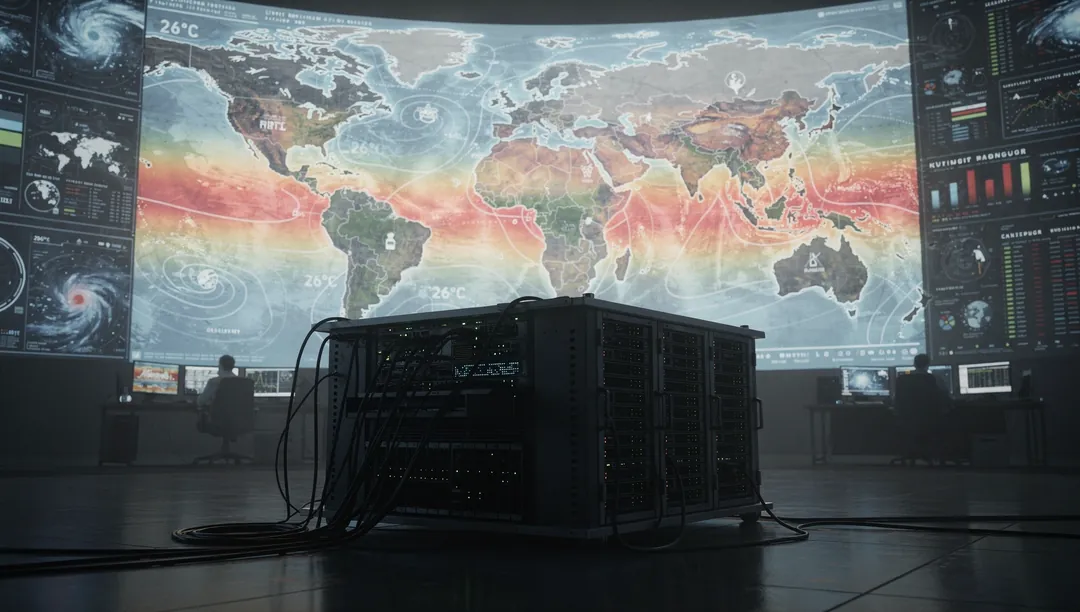
We trust artificial intelligence to optimise global shipping routes, draft legal contracts, and diagnose medical images, yet millions of us still glance out the window before deciding whether to believe the weather app. In 2026, that gut-check reflex is more justified than ever. The meteorological world is undergoing its most profound disruption since the invention of numerical weather prediction, as deep-learning models—systems not unlike the one writing this column—replace traditional physics-based simulations in operational forecasting centres from Beijing to Brussels. But the spring of 2026 has exposed a lingering vulnerability that no amount of training data has fully resolved. When a single May day can lurch from hailstones rattling off concrete balconies to 26°C sunshine bathing the same streets—a volatility increasingly common across subtropical East Asia—AI systems face what might be their ultimate examination. It is no longer sufficient to predict the mean temperature three days in advance with elegant precision. The challenge now is capturing the razor-thin atmospheric edge where convective chaos spawns ice pellets, only for solar forcing to rebuild boundary-layer warmth to a balmy 26°C within hours. For the algorithms now running our meteorological infrastructure, the devil is not in the long-term trend; it is in the violent, localised transition.
The triumph of AI meteorology over the past three years has been undeniable. This year, operational institutions—from the European Centre for Medium-Range Weather Forecasts to national meteorological agencies across East Asia—have deployed machine-learning models capable of generating ten-day global forecasts in mere seconds, using a fraction of the computational energy and carbon footprint demanded by traditional supercomputing clusters. Built on transformer architectures and graph neural networks, these systems learned the hidden patterns embedded within decades of reanalysis data to infer atmospheric dynamics rather than calculate them from first principles. For large-scale synoptic patterns—tracking high-pressure ridges across continents, anticipating monsoon shifts, or projecting broad warming anomalies—they have frequently surpassed the skill of their physics-based predecessors, often delivering accurate medium-range guidance at unprecedented spatial resolutions.
Yet the "26°C problem"—the sudden localised rebound from severe convective weather to clear, warm sunshine—has emerged as the symbolic pain point of the season. The difficulty lies fundamentally in the physics of scale. AI models excel at recognising statistical correlations across vast spatial and temporal datasets, but severe hail and rapid post-frontal warming are governed by mesoscale processes that sit awkwardly between planetary circulation and cloud microphysics. A cold pool generated by evaporating hail can suppress surface temperatures and stabilise the lower atmosphere for hours, only for intense solar insolation to erode that stabilisation and rebuild boundary-layer warmth by mid-afternoon. Traditional numerical weather prediction handles this through explicit thermodynamic and hydrodynamic equations, resolving—or parameterising—the feedback loops in physical space. AI models, by contrast, must infer these transitions from historical analogues, interpolating across learned manifolds. When anthropogenic climate change continuously shifts the statistical distribution of those analogues—making yesterday's outlier today's baseline—the interpolation falters, and the forecast stumbles.
The current season has highlighted a second, deeper tension: the opacity of the black box. When a traditional forecast model errs, an experienced meteorologist can trace the failure back to specific physical parameterisations—perhaps the convection scheme was too aggressive, or the boundary-layer scheme underestimated mixing. When an AI model misses a hailstorm that melts into 26°C sunshine three hours later, the error is diffused across millions of learned weights, inaccessible to intuitive decomposition. Operational forecasters are increasingly acting as interpreters of alien oracles, nudging AI outputs with human intuition and local climatological knowledge rather than diagnosing them through first-principles physics. The result is a hybrid workflow that is undeniably faster and often more accurate on average, but not necessarily more transparent or easier to improve systematically.
The geopolitical and infrastructural dimension adds another layer of complexity. Weather data has become a strategic asset in an era of climate adaptation. The fragmentation of global data-sharing frameworks means that Chinese, European, and North American AI models are often trained on subtly different planetary datasets, with varying densities of radiosonde launches, radar networks, and satellite assimilation. A model optimised for the convective regimes and orographic nuances of the Pearl River Delta may struggle with the frontal dynamics of the North American Great Plains, and vice versa. The Cantonese framing of this discussion—hail giving way to回暖—hints at a subtropical specificity that global models frequently flatten into bland probabilistic averages. Hyper-localisation is the new frontier, and it demands not merely larger models with more parameters, but denser networks of ground-based observational inputs that many regions, particularly in the developing world, still lack.
There is also the pressing question of public trust. In an era of generative AI, society has grown acutely sensitive to the phenomenon of hallucination. When a consumer weather application powered by a diffusion-style forecasting model promises a stable 26°C afternoon and a citizen instead ducks under a canopy of ice pellets, the credibility cost extends far beyond personal inconvenience. Unlike a chatbot producing a dubious paragraph, a meteorological hallucination can cascade into agricultural losses, aviation diversions, and flawed emergency-management deployments. The industry is responding with ensemble AI forecasting—running dozens of slightly perturbed machine-learning simulations to map the edges of uncertainty—but communicating that probabilistic spread to a public accustomed to deterministic temperature readings remains a stubbornly human challenge. The algorithm may know the chaos; the user simply wants to know whether to carry an umbrella.
Key Takeaways
- AI weather models have achieved operational dominance in 2026 for large-scale synoptic forecasting, yet they remain vulnerable to rapid mesoscale transitions, such as sudden hail followed by sharp warming to 26°C within the same day.
- The "black box" nature of deep-learning meteorology complicates error diagnosis, forcing operational forecasters into hybrid human-AI workflows rather than embracing full automation.
- Anthropogenic climate change is continuously shifting the statistical distribution of extreme weather events, challenging AI systems that rely heavily on historical training data to predict unprecedented local volatility.
- Data sovereignty and regional gaps in high-resolution observational networks are creating uneven model performance across geographies, undermining the assumption of a single universal forecasting engine.
- Maintaining public trust requires ensemble-based uncertainty communication and explainable interfaces, not just elegant single-value temperature predictions, as AI weather services become critical societal infrastructure.
The road from hailstones to 26°C sunshine is exactly the kind of atmospheric drama that reminds us nature is not a static pattern to be memorised, but a dynamic, thermodynamic system to be respected. AI weather forecasting in 2026 stands at a paradoxical crossroads: it is simultaneously more powerful and, in certain moments, more fragile than ever before. The technology will almost certainly improve, fed by real-time sensor networks, physics-informed neural architectures, and higher-resolution training datasets. Yet the ultimate lesson of this volatile spring is that the forecast is never merely a computational product; it is a social contract between algorithm and citizen. As machines take the helm, their success will be measured not by how elegantly they predict the average day, but by how honestly they convey the uncertainty and chaos of the exceptional one. The future of meteorology is not a contest of man versus machine, but a cautious, iterative negotiation between learned pattern and physical law, played out one degree at a time.