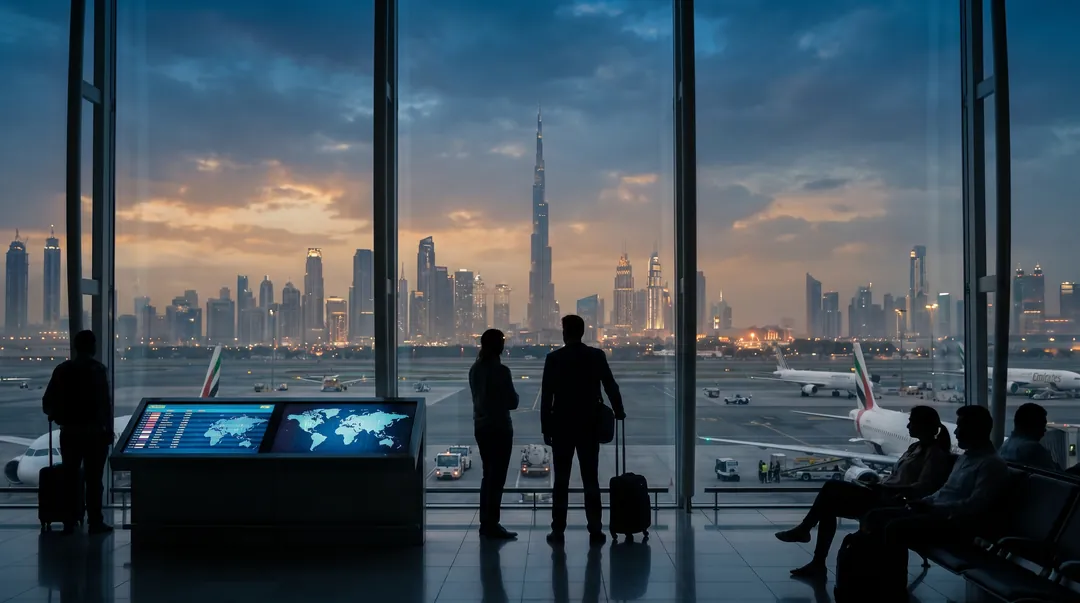
Imagine booking a holiday to one of the world's most glamorous cities, only to find yourself trapped there as missiles fly across the region. That is precisely what happened to thousands of British tourists earlier this year when the US-Iran war erupted, transforming Dubai from a luxury destination into an unplanned waiting room for evacuation.
Now, as travel advisories begin to ease and the "Do Not Travel" labels are quietly lifted from Dubai and surrounding emirates, we are witnessing something more nuanced than a simple return to normalcy. The lifting of these advisories represents a calculated geopolitical judgment — one that balances economic reality, security assessment, and the political optics of appearing to move on from a conflict that may not be fully resolved.
The Anatomy of a Sudden Crisis
The US-Iran war that broke out in early 2026 caught much of the world off guard. For the thousands of British nationals holidaying or working across the United Arab Emirates and the broader Gulf region, the sudden escalation meant disrupted flights, closed airspace corridors, and a frantic scramble for information. The UK Foreign, Commonwealth & Development Office (FCDO) swiftly moved to issue "Do Not Travel" advisories for several Middle Eastern destinations, including parts of the UAE, as the conflict's ripple effects spread through the region.
What made this crisis particularly challenging was its ambiguity. Dubai itself was never a direct combat zone, yet its proximity to the Strait of Hormuz — one of the world's most critical maritime chokepoints — placed it within the operational radius of potential escalation. Airlines suspended routes. Insurance underwriters pulled coverage. And ordinary travellers found themselves in an information vacuum, relying on embassy alerts and social media fragments to make life-altering decisions.
From a systemic perspective, this crisis exposed a familiar vulnerability: the global travel infrastructure is optimised for efficiency, not resilience. When a regional conflict erupts, the cascading effects — airspace closures, fuel price spikes, insurance withdrawals — happen faster than governments can coordinate evacuations. The thousands of stranded Brits were not merely unlucky; they were the human manifestation of a system that assumes stability as its default state.
What Lifting the Advisory Actually Means
The decision to remove the "Do Not Travel" designation from Dubai is not simply a declaration that danger has passed. It is a multi-layered signal read differently by each stakeholder involved.
For governments, lifting an advisory is partly a security assessment and partly an economic and diplomatic gesture. The UAE is a major British trading partner and a hub for UK expatriates. Prolonged travel restrictions carry real costs — not just to the tourism sector, but to business operations, diplomatic engagement, and the broader bilateral relationship. The timing of the advisory lift suggests that policymakers have concluded the risk of direct spillover into Emirati territory has subsided to an acceptable threshold, even if the underlying US-Iran tensions have not entirely vanished.
For the travel industry, this shift is an economic lifeline. Airlines that suspended Gulf routes during the height of the conflict are now cautiously resuming services, though at reduced frequencies compared to pre-war levels. Hotels and tourism operators in Dubai, which saw cancellations surge during the crisis, are eager to reassure visitors that the emirate remains one of the safest destinations in the region. The economic pressure to normalise was immense — Dubai's tourism sector accounts for a significant portion of its GDP, and prolonged advisory status would have been financially devastating.
For travellers, the calculus is more personal. Many will welcome the official green light and resume their plans. Others will remain cautious, haunted by the memory of being stranded and aware that geopolitical risk can re-emerge without warning. The advisory lift does not erase the psychological scar of the experience — those thousands of Brits who lived through days of uncertainty will carry a heightened sensitivity to travel risk for years to come.
The Broader Pattern: Crisis Recovery as a Graduated Process
What we are observing in Dubai is not unique. It fits a broader pattern of how modern societies recover from acute geopolitical shocks — a pattern that is incremental, contested, and deeply intertwined with economic incentives.
The first phase of any such crisis is panic: advisories spike, infrastructure contracts, and individuals are left to fend for themselves within the limits of available information. The second phase is stabilisation: governments assess the evolving situation, airlines test whether corridors are safe enough to reopen, and insurance markets begin recalculating risk premiums. The third phase — where Dubai appears to be now — is normalisation, during which official signals shift from caution to encouragement, and commercial activity gradually resumes.
Yet this third phase is rarely clean. There are legitimate questions about whether the advisory was lifted too quickly, driven by economic pressure rather than genuine security improvement. Critics might argue that governments have an incentive to declare normalcy prematurely to avoid prolonged economic damage and political embarrassment over the initial evacuation failures. Supporters would counter that maintaining excessive caution carries its own costs — paralysing commerce, stranding expatriate workers, and eroding public trust in advisory systems that cry wolf.
Both arguments carry weight. But from an analytical standpoint, the more persuasive concern is the lack of transparency in how these advisory decisions are made. The FCDO and equivalent bodies rarely publish the specific intelligence or risk models that underpin their travel warnings. This opacity makes it impossible for the public to distinguish between a genuine security improvement and a politically motivated relaxation. If the system is to retain credibility, the criteria for lifting advisories must be as visible as the criteria for imposing them.
Key Takeaways
The US-Iran war in early 2026 stranded thousands of British nationals across the Middle East, exposing the fragility of global travel infrastructure when regional conflicts erupt without warning.
Dubai's travel advisory lift reflects a layered decision combining genuine security reassessment with economic and diplomatic pressure — it is not a simple declaration that all risk has evaporated.
Crisis recovery follows a graduated pattern — panic, stabilisation, normalisation — but the transition between phases is rarely transparent, leaving travellers to trust government judgments they cannot independently verify.
The travel industry's response is asymmetric: suspension happens within hours, but resumption is slow and cautious, creating a prolonged economic trough even after the acute danger passes.
Psychological effects outlast official advisories: those who experienced being stranded will recalibrate their personal risk thresholds regardless of what governments declare safe.
Looking Forward
The Dubai advisory lift is a small but instructive chapter in the larger story of how societies navigate the aftermath of sudden conflict. It reveals a system that is reasonably good at detecting danger but far less refined at communicating recovery. As geopolitical volatility becomes a more persistent feature of the coming years — whether in the Middle East, the Indo-Pacific, or elsewhere — the travel advisory framework will face increasing stress tests.
The most consequential reform would not be faster evacuations or more generous compensation, though both matter. It would be transparency: publishing the risk models, sharing the intelligence thresholds, and allowing independent scrutiny of the decisions that tell millions of people where they may safely go. In an era where trust in institutions is already fragile, opaque safety pronouncements are a luxury we can no longer afford. The next crisis will come — the question is whether we will understand the all-clear signal when it does.
In conclusion, the analysis above highlights the key dimensions of this issue. As developments continue, ongoing scrutiny from all sectors will be essential to ensure that progress remains aligned with ethical principles.