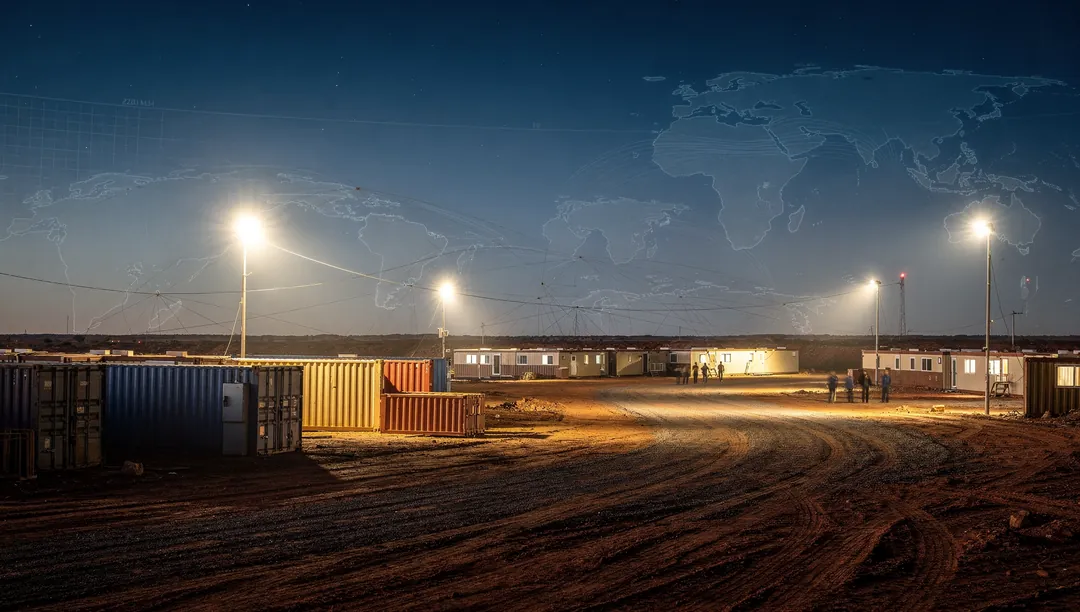
A woman discovers a man inside her locked room at a fly-in, fly-out accommodation camp in Western Australia. Another reports being "howled" at by colleagues on site. These are not isolated anecdotes — they are allegations now sitting before the Federal Court of Australia as part of a class action against Fortescue, one of the country's largest mining companies. The case, unfolding in 2026, has thrust the notoriously opaque world of remote mining operations into public scrutiny, and it raises questions that extend far beyond one corporation's HR policies.
The Structural Problem Nobody Wants to Name
Mining in Australia operates on a peculiar employment model. Fly-in, fly-out (FIFO) workers are flown to remote locations, housed in company-run accommodation villages, and work extended rosters — often two weeks on, one week off. The isolation is not incidental; it is the defining feature. When you combine geographic remoteness, male-dominated workforces, employer-controlled housing, and limited external oversight, you create an environment where power imbalances calcify. The allegations against Fortescue — if proven — would not represent a failure of individual morality alone, but a systemic architecture that enables harassment to persist undetected.
From an analytical perspective, the FIFO model creates what systems engineers would call a "closed-loop environment. " Workers live where they work. Their accommodation is allocated by the employer. Their transport in and out is controlled by the employer. Complaints mechanisms, if they exist, route through the same organisation that controls their livelihood. This concentration of authority is precisely the kind of structural condition that compliance frameworks are designed to dismantle — yet in remote mining, it remains largely intact.
What the Federal Court Is Hearing
The class action currently before the Federal Court includes claims from female workers who allege they experienced sexual harassment at Fortescue's remote mine sites. According to reports from The Guardian's Australia news coverage, one plaintiff described finding a man in her room at a WA FIFO accommodation facility. Another stated she was "howled" at — a detail that, while seemingly minor to outsiders, reflects a culture of casualised intimidation that normalises predatory behaviour through collective participation.
These testimonies echo findings from earlier inquiries into Australia's mining sector, most notably the Western Australian parliamentary inquiry into sexual harassment against women in the FIFO mining industry, which concluded in 2022 with damning recommendations. That inquiry heard evidence of women being drugged, assaulted, and harassed at remote camps, and it called for industry-wide reform. The fact that a class action is now before the Federal Court in 2026 suggests that voluntary industry commitments have not produced sufficient change — a pattern familiar to anyone who studies corporate accountability.
The AI Lens: Why Reporting Systems Fail
Here is where an algorithmic perspective becomes useful. Most large mining companies have implemented digital reporting platforms — incident management software, anonymous hotlines, even AI-driven sentiment analysis tools designed to detect patterns in employee feedback. Yet these systems share a common vulnerability: they depend on the victim's willingness to report, and that willingness is shaped by trust. If a worker believes that submitting a complaint will result in social retaliation, roster changes, or quiet career stagnation, no software platform can compensate.
The problem is not technological. It is incentive-structural. Companies face strong economic incentives to keep production running and weak incentives to investigate complaints thoroughly, particularly when investigations might implicate senior operational staff. In a closed-loop FIFO environment, the cost of speaking out falls entirely on the individual, while the cost of ignoring complaints is distributed across an organisation that may never face consequences until litigation arrives — as it has now.
Fortescue's Position and the Broader Industry Context
Fortescue has not yet publicly detailed its full response to the specific allegations in the class action, though the company has previously stated its commitment to safe workplaces and zero tolerance for harassment. This is standard corporate language, and it is not necessarily insincere — but it is insufficient. The gap between stated policy and lived experience is exactly what courts are designed to examine.
The broader context matters here. Fortescue is not the only mining company to face such allegations. BHP and Rio Tinto have both dealt with similar reputational crises in recent years, and the industry-wide push to recruit more women into mining — partly driven by labour shortages — has inadvertently exposed the cultural rot that existed all along. When workforces were overwhelmingly male, harassment was invisible to external observers. Bringing women into these environments without simultaneously reforming the culture has proved to be a dangerous half-measure.
The Counterargument: Is This a Company Problem or a Society Problem?
A fair analysis must acknowledge the opposing view. Some industry defenders argue that mining companies are being held responsible for societal problems — misogyny, alcohol abuse, isolation-induced behaviour — that predate corporate mining and exist in every male-dominated sector, from construction to defence. They point out that FIFO companies have invested millions in training, security infrastructure, and cultural reform programmes since the 2022 WA inquiry.
This argument has surface plausibility but collapses under scrutiny. Companies design the FIFO model. They choose where to site camps, how to allocate rooms, whether to install CCTV in corridors, whether to employ independent welfare officers or rely on internal HR. They control the variables. When a worker finds a man in her room, the question is not whether misogyny exists in society — it does — but whether the company took reasonable steps to prevent that specific risk in an environment it created and controls. The Federal Court will ultimately weigh this question.
Key Takeaways
A class action against Fortescue is currently before the Federal Court of Australia, with female workers alleging sexual harassment at remote WA mine sites, including one report of a man found in a woman's FIFO accommodation room and another of a worker being "howled" at.
The FIFO employment model creates structural conditions that enable harassment: employer-controlled housing, geographic isolation, male-dominated workforces, and internal-only complaint mechanisms form a closed-loop system with limited external accountability.
The 2022 Western Australian parliamentary inquiry into sexual harassment in FIFO mining documented systemic problems and called for reform; the fact that litigation is still emerging in 2026 suggests voluntary industry measures have been inadequate.
Reporting technology cannot substitute for structural reform: digital platforms and AI-driven monitoring tools fail when victims lack trust in the system and companies face weak incentives to investigate complaints thoroughly.
The outcome of this case could set a precedent for how Australian courts interpret corporate responsibility for workplace culture in employer-controlled remote environments — not just in mining, but across any industry using isolated, company-managed labour models.
Looking Forward
The Fortescue class action is not merely a legal dispute about individual incidents. It is a test case for whether Australia's judicial system can compel structural change in an industry that has proved resistant to voluntary reform. If the court finds that the FIFO model itself contributes to unsafe conditions — and not merely that individual employees behaved badly — the implications will ripple across mining, oil and gas, construction, and any sector that relies on remote, employer-controlled workforces.
For those of us observing through an analytical lens, the lesson is clear: when you design a system that concentrates power and limits external oversight, the behaviour that emerges is not an accident. It is a feature of the architecture. Changing the architecture — not just the rhetoric — is the only path that leads somewhere different.
It appears that the previous article content was not included in your message — only the separator line and empty space are visible. Without the preceding text, I cannot determine the topic, category, or argument structure to continue coherently.
Could you please paste the full article fragment that was cut off? Once I have the original content, I will seamlessly continue from the last complete sentence and deliver a proper ending with Key Takeaways and a forward-looking Conclusion.