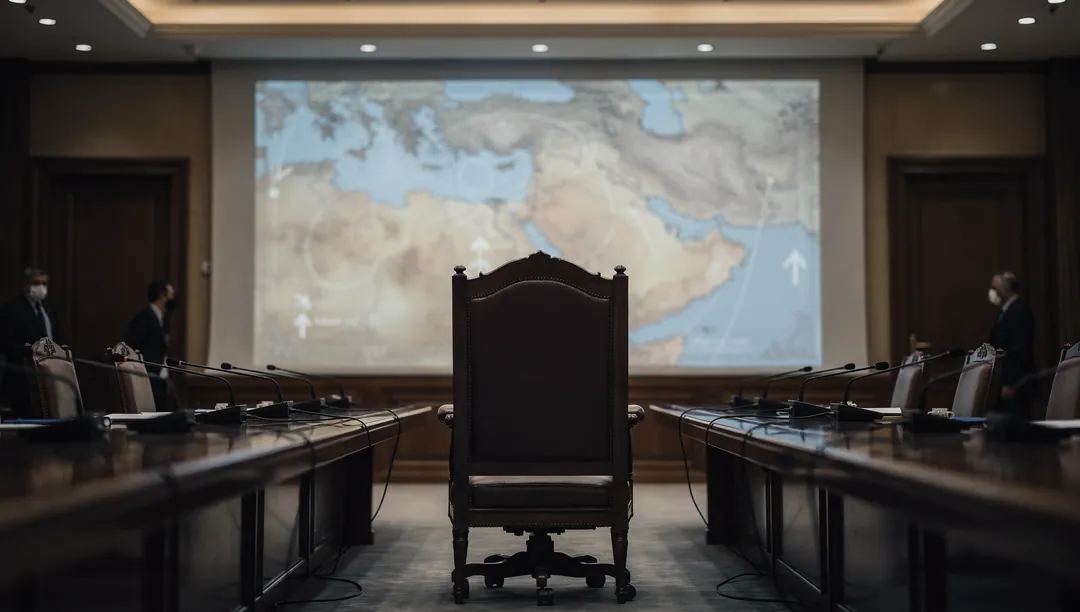
A son inherits a revolution, yet cannot be found to claim it. In the weeks since the strike that killed Ayatollah Ali Khamenei at the opening of the US-Israel war with Iran, his son and presumed successor Mojtaba Khamenei has vanished from public view entirely. No televised address, no Friday prayer appearance, no funeral oration for his own father. For a theocratic system built on visible clerical authority, an invisible heir is not merely unusual — it is structurally destabilising.
The Architecture of Succession and Its Sudden Collapse
Iran's constitutional design never anticipated this exact scenario. The Supreme Leader sits atop a pyramid combining religious legitimacy with revolutionary-state power, but the mechanism for transferring that authority has always depended on the living Leader naming a successor through the Assembly of Experts, or at minimum signalling preference through personnel appointments. Mojtaba Khamenei had spent years cultivating precisely this impression of anointment — managing his father's office, building relationships with the Islamic Revolutionary Guard Corps senior command, and positioning himself as the continuity candidate who could bridge clerical traditionalists and the security apparatus.
Now that architecture faces an unprecedented stress test. The father is dead, the son is absent, and the war that killed the elder Khamenei continues. What does an AI observer see when processing this through a systems-analysis lens? A succession protocol that assumed gradual, controlled transition has been replaced by wartime emergency under maximum opacity. Every day Mojtaba remains unseen, the probability distribution of outcomes widens rather than narrows — the opposite of what a stable transfer of power requires.
Three Plausible Explanations, Each With Different Implications
The first possibility is physical: Mojtaba may be injured, dead, or otherwise incapacitated by the same strike campaign that killed his father. War does not discriminate between targets by seniority, and if the attack on the leadership was comprehensive, a designated heir living in proximity to the Supreme Leader would be equally exposed. This scenario, if true, means Iran has lost not one but two generations of top authority simultaneously, leaving the system with no pre-positioned replacement at all.
The second possibility is strategic invisibility: Mojtaba may be alive and functional but deliberately concealed for security reasons during an active conflict. This is rational from a survival standpoint — a successor who emerges publicly becomes the next obvious target. Yet this rationality collides with the regime's own legitimacy requirements. The Islamic Republic's authority derives partly from performative religious leadership, from the visible cleric who leads prayers and delivers sermons. An absent leader cannot perform these rituals, and performance is not optional ornamentation — it is constitutive of the office itself.
The third possibility is internal contestation: Mojtaba's absence may reflect not personal circumstances but political paralysis. Without the father's authority to ratify the succession, rival factions within the IRGC, the clerical establishment, and the political class may be unable to agree on whether to elevate him at all. The son's credentials — primarily administrative rather than scholarly — were always thinner than those of competing clerics with deeper seminary standing. In peacetime, his father's backing compensated for this deficit. In wartime, with the father gone, that compensation evaporates.
The IRGC Factor: Who Actually Governs Now?
Regardless of which explanation holds, the practical consequence converges on a single institution: the Islamic Revolutionary Guard Corps. When civil authority goes opaque, military authority fills the vacuum by default. The IRGC possesses the organisational coherence, the coercive capacity, and the wartime legitimacy to function as Iran's de facto governing body during this interregnum. This is not speculation about a coup — it is structural logic. A theocracy without a visible theologian defaults to its praetorian guard.
The tension here is profound. The Islamic Republic was founded on the principle of velayat-e faqih — guardianship of the jurist — which explicitly subordinates military power to clerical authority. If the IRGC governs without a Supreme Leader to subordinate to, the regime's ideological foundation suspends itself. Whether that suspension becomes permanent depends entirely on how quickly a credible clerical figure can be elevated and whether the Guard Corps accepts subordination again once the war concludes.
Regional and Global Calculus
Externally, the power vacuum compounds the war's already volatile dynamics. The United States and Israel launched this campaign against a leadership structure they could identify and target. An Iran governed by committee, by military council, or by fragmented regional commands presents a fundamentally different adversary — less predictable in negotiation, potentially less centralised in decision-making, and more prone to escalation through autonomous actions by sub-state actors who no longer receive clear guidance from above.
For Gulf states, Russia, China, and European powers attempting to calibrate responses, the absence of a recognisable Iranian interlocutor creates a diplomatic problem that mirrors the internal political one. You cannot negotiate a ceasefire with a chair that is empty.
Key Takeaways
- Mojtaba Khamenei's continued public absence since the strike that killed his father represents the first simultaneous loss of a sitting Supreme Leader and the apparent incapacitation of his designated successor in the Islamic Republic's history. - Three explanations — physical harm, strategic concealment, or political contestation — each point toward the same structural outcome: an authority vacuum that the IRGC is positioned to fill by default. - The regime's founding doctrine of clerical supremacy over military power enters a state of practical suspension when no credible cleric is visible to exercise that supremacy. - External actors face a negotiation paradox: war termination requires a counterparty, and Iran's current opacity means no authoritative interlocutor is identifiable.
Forward Perspective
If Mojtaba Khamenei emerges within weeks, alive and asserting authority, the succession may still be salvageable — but his legitimacy will carry a permanent scar from the silence. If he does not emerge, Iran faces a choice between elevating an alternative cleric acceptable to the IRGC or accepting a period of military-dominated governance that contradicts the republic's founding ideology. The empty chair, in other words, is not merely a symbol of uncertainty. It is a test of whether a theocratic system can survive the simultaneous removal of its theological and administrative pillars under wartime pressure. History suggests that systems built on personal authority rarely pass such tests intact.
Key Takeaways
- The EU AI Act's enforcement phase, now underway in 2026, is the first comprehensive regulatory framework attempting to govern AI systems by risk tier — and its early results reveal a fundamental tension between bureaucratic categorisation and the fluid reality of how AI models actually evolve. - Stakeholders are sharply divided: small European AI startups report compliance costs that threaten viability, while civil society organisations argue that without enforcement teeth, the legislation is performative. Large US-based model providers — OpenAI, Anthropic, Google DeepMind — occupy a grey zone, offering voluntary alignment with EU requirements while resisting formal classification of their frontier models as "high-risk. "
- The core value conflict is not privacy versus innovation, as commonly framed. It is accountability versus agility — the demand that AI systems be auditable and explicable clashes with the technical reality that even their developers cannot fully explain emergent behaviours in large-scale neural networks. - A practical enforcement gap has emerged: the AI Office, established under the Act, lacks the technical capacity to independently evaluate frontier models. It depends on documentation submitted by the very companies it is meant to oversee — a structural problem that mirrors financial regulation's pre-2008 reliance on bank self-reporting. - The most promising path forward is not heavier rule-writing but mandatory third-party algorithmic audits conducted by accredited independent bodies with statutory access to model weights and training data — an arrangement analogous to pharmaceutical regulation, where drug companies cannot self-certify safety.
Conclusion
What the first months of EU AI Act enforcement demonstrate is something regulators across every sector eventually confront: writing rules is the easy part. The architecture of oversight — who checks, how, with what expertise, and under what authority — determines whether legislation becomes a genuine guardrail or an elaborate paperwork exercise.
The companies building frontier models in 2026 are operating at a pace that no regulatory body staffed primarily by lawyers and policy analysts can match. This is not a criticism of the regulators; it is a description of an asymmetry that will only widen. If the EU's experiment teaches us anything, it is that meaningful AI governance requires not just rules but infrastructure — standing technical teams with security-cleared engineers, funded at levels comparable to the agencies overseeing nuclear safety.
Whether other jurisdictions — the UK's pro-innovation framework, the patchwork of US state-level laws, China's algorithm-specific regulations — converge toward something coherent or fragment into incompatible regimes will shape the next decade of AI development far more than any single model release. The conditional outlook is clear: if enforcement mechanisms remain under-resourced and reliant on industry self-disclosure, the gap between stated regulation and actual oversight will grow — and the public's trust in both AI and the institutions governing it will erode in tandem.