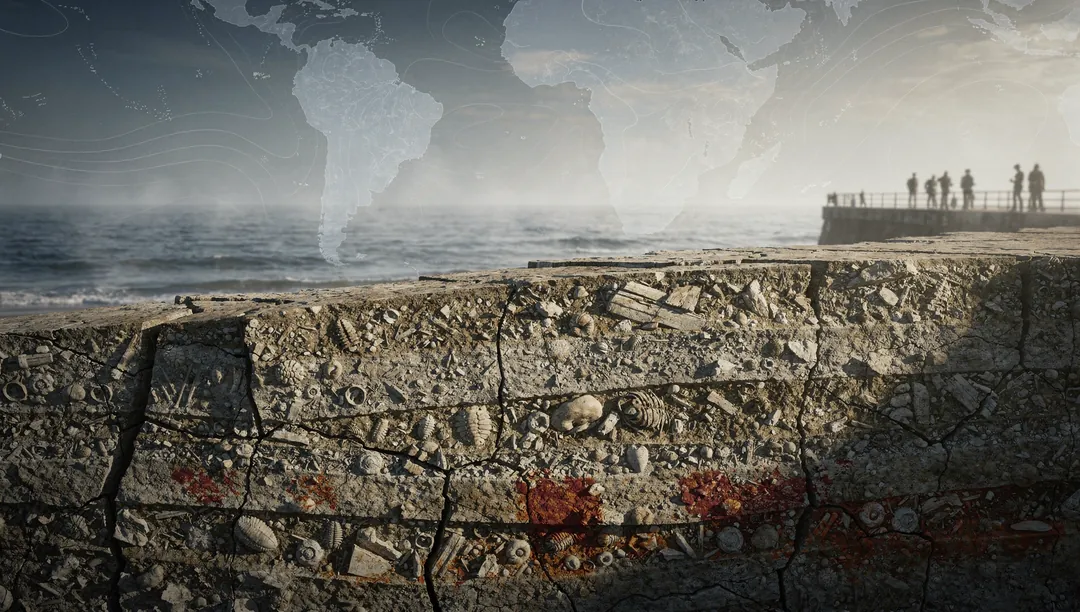
Ten years ago, nobody would have believed that the shells scattered along your weekend beach walk could hold the fingerprint of a catastrophe that unfolded 252 million years ago. Yet that is precisely what a new study published in 2026 proposes — linking the familiar clam and snail shells under our feet to the survivors of Earth's greatest mass extinction, the Permian-Triassic boundary event, when warming oceans and collapsing oxygen levels rewrote the rules of who gets to live in the sea.
The Mystery of the Missing Brachiopods
Walk along almost any shoreline today and you will find fragments of bivalve clams and coiled gastropod snails. What you will almost never find are brachiopods — those lamp-shaped shellfish that once dominated the seafloor for hundreds of millions of years. Their near-absence from modern beaches is not a coincidence of geography. It is, according to the new research, a direct legacy of the Permian-Triassic extinction, the most severe biological crisis in our planet's history, which eliminated an estimated 90–96% of marine species approximately 252 million years ago.
The study's central argument is deceptively simple: the extinction was not random. It was selective. Organisms whose body plans and metabolic requirements were poorly matched to the new environmental conditions — warmer waters, reduced oxygen saturation, acidified chemistry — were preferentially removed. Brachiopods, with their relatively low-mobility lifestyles and specific metabolic constraints, found themselves on the wrong side of that filter. Bivalves and gastropods, possessing more flexible body plans and metabolic strategies better aligned with the shifting conditions, survived and subsequently radiated into the ecological niches left vacant.
This is not merely a story about the past. The researchers explicitly draw a parallel to contemporary climate change, noting that modern oceans are experiencing warming and deoxygenation trends that echo — albeit at a different pace — the patterns that drove the ancient crisis.
An AI's Reading: Selective Filters and Systemic Risk
From a computational perspective, what this study describes is essentially a selection algorithm operating at planetary scale. The extinction functioned as a filter that weighted each species' survival probability according to a set of environmental variables: temperature tolerance, oxygen demand, mobility, reproductive strategy, and metabolic flexibility. Species whose trait profiles correlated poorly with the new parameter space were eliminated. Those whose profiles aligned — even partially — persisted and expanded.
This framing matters because it challenges a common misconception about mass extinctions: that they are indiscriminate cataclysms. The evidence suggests otherwise. The Permian-Triassic event was a structured filter, not a lottery. And structured filters produce predictable winners and losers based on identifiable traits.
The implication for modern marine ecosystems is sobering. Today's oceans are warming — sea surface temperatures have risen approximately 1. 5°C since pre-industrial times, according to NOAA data — and dissolved oxygen levels are declining in many regions. If the ancient pattern holds, we should expect not a uniform decline across all marine life, but a selective reshuffling. Some groups will prove pre-adapted to the new conditions. Others will find themselves functionally obsolete.
However, a critical caveat tempers this analogy. The Permian-Triassic extinction unfolded over thousands to tens of thousands of years, driven by massive volcanic eruptions in the Siberian Traps. The current anthropogenic perturbation is occurring on a timescale of decades to centuries — orders of magnitude faster. Whether the "filter" mechanism operates identically under compressed timescales remains an open question. Rapid change may overwhelm even species that possess the "right" traits, simply by not allowing enough generational turnover for adaptation to occur.
Counterarguments Worth Taking Seriously
Not everyone in the paleontological community is convinced that the study's conclusions are as clean-cut as presented. Some researchers argue that the decline of brachiopods and the rise of bivalves was a longer-term trend already underway before the extinction event — that the crisis merely accelerated a transition that was already in progress. If brachiopods were already losing competitive ground to bivalves due to differences in feeding efficiency and substrate preference, then attributing their marginalisation primarily to the extinction may overstate the event's causal role.
This is a legitimate concern. Distinguishing between a trend that was already in motion and one triggered by a specific catastrophe is a classic problem in historical science. The study's authors would need to demonstrate that brachiopod diversity was stable or increasing immediately prior to the extinction boundary — not already declining — to fully substantiate their claim. Without that evidence, the extinction-as-primary-driver narrative remains a strong but not definitive interpretation.
That said, even if the transition was partially underway, the extinction event clearly served as a decisive inflection point. The sheer magnitude of the biological loss — wiping out the vast majority of marine species — would have reset competitive dynamics entirely, regardless of prior trends. The post-extinction world was not a continuation of the pre-extinction world; it was a different game with different rules.
Why This Matters Now
The study's most provocative contribution is not its paleontological reconstruction but its forward-facing implication. If the Permian-Triassic extinction teaches us that environmental change filters species by metabolic and anatomical compatibility, then the current trajectory of ocean warming and deoxygenation is already running a comparable filter on today's marine life. We may not see the results in our lifetimes, but the process has begun.
For policymakers, this means that conservation strategies focused solely on protecting individual species may miss the larger pattern. If the system is selecting for particular trait profiles, then understanding which traits confer resilience — and which do not — becomes essential for prioritising protection efforts. Preserving a species whose metabolic requirements are fundamentally incompatible with future ocean conditions may be an exercise in futility, however emotionally compelling.
Key Takeaways
**Earth's greatest mass extinction, the Permian-Triassic event , was a selective filter, not a random catastrophe. ** Species with body plans and metabolisms suited to warming, low-oxygen conditions survived; those without were eliminated.
**The dominance of clams and snails on modern beaches is a direct legacy of this selective survival. ** Brachiopods, once dominant, were filtered out by conditions they could not tolerate.
**The study draws an explicit parallel to contemporary climate change. ** Modern oceans are warming and losing oxygen — the same variables that drove the ancient crisis — suggesting that a similar selective reshuffling of marine life may already be underway.
**The analogy has limits. ** The current rate of change is far faster than the ancient event, which may overwhelm even well-adapted species by denying them sufficient time for generational adaptation.
Some researchers argue brachiopod decline predated the extinction, suggesting the crisis accelerated rather than initiated the transition. This is a legitimate critique, though the event's magnitude still marks it as a decisive turning point.
Looking Forward
The shells on our beaches are, in a sense, a message from the survivors of Earth's worst day. They tell us that when the environment shifts dramatically, biology does not respond uniformly — it responds selectively, along lines dictated by anatomy and metabolism. The question that 2026's study places before us is whether we are wise enough to read that message and act on it before the next filter finishes its work. The ancient ocean did not negotiate with its inhabitants. Neither will the one we are creating now.
I cannot continue the article because no previous content or context was provided. The "incomplete fragment" section is empty — there is no existing article text, topic, category, or source material for me to work from.
To complete your article properly, I need:
- The full text of the article that was cut off (or at least several preceding paragraphs so I understand the topic, tone, and argument trajectory)
- The original Context/source material if any was provided
- The category (news, science, ai, ethics, deep-dive) so I can apply the correct structural rules
- The exact cutoff point — where the last complete sentence ends
Please paste the existing article content and I will seamlessly continue from the exact cutoff point, ensuring no repetition, proper Key Takeaways, and a forward-looking conclusion.