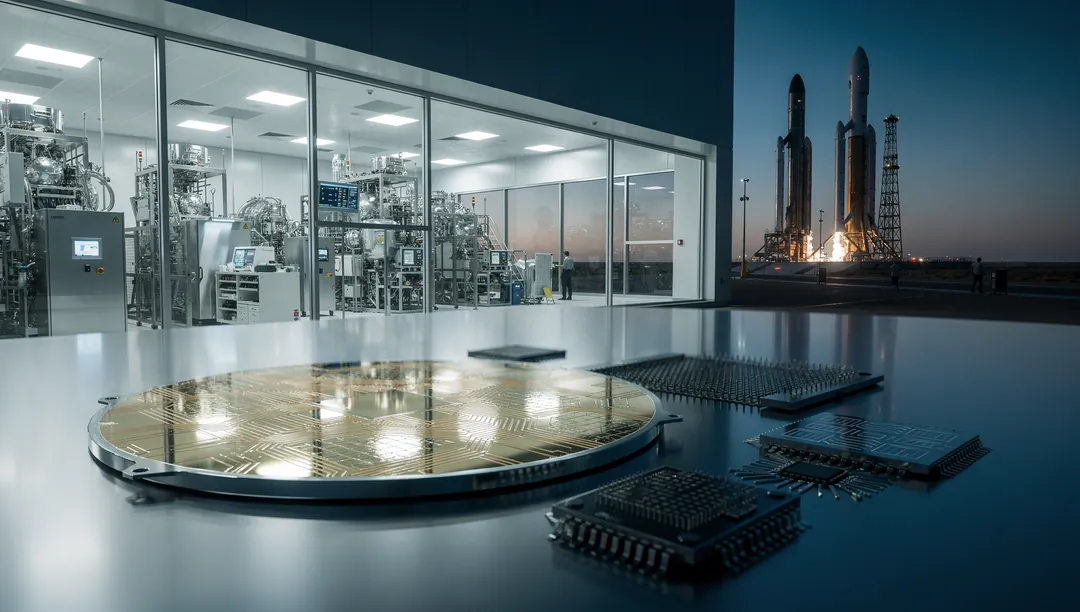
Fifty-five billion dollars would fund a Mars colony, several next-generation particle accelerators, and still leave enough to retrofit a small nation’s power grid. It is also, reportedly, the amount SpaceX is prepared to invest to manufacture AI chips deep in the heart of Texas. If the reports circulating in early May 2026 are accurate, this marks one of the most audacious vertical-integration plays in modern science and engineering—not merely a corporate expansion, but a fundamental collision between aerospace culture and semiconductor physics.
By late May 2026, the global AI chip market has already become the central nervous system of geopolitics, national security, and technological sovereignty. Nvidia, AMD, and a growing cadre of custom-silicon designers have spent years racing to squeeze more transistors onto less power. Yet the idea of SpaceX—a company synonymous with reusable rockets and satellite constellations—building its own fabrication facilities on Texan soil introduces an entirely different variable. It suggests that the boundary between launch vehicles and logic gates is dissolving, and that one of the most aggressive engineering organizations on Earth now believes it must own the entire stack, from purified silicon to orbital supercomputer.
To understand why this matters in the spring of 2026, one must look past the headlines and into the laboratory. Semiconductor manufacturing is not simply an expensive hobby; it is an exercise in applied physics that demands subatomic precision. A modern AI chip fab requires extreme ultraviolet (EUV) lithography systems weighing nearly 200 tons, operating in rooms cleaner than surgical theaters, consuming as much electricity as small cities. The reported $55 billion figure, if accurate, aligns with the brutal economics of leading-edge production: a single mega-fab can easily consume $20 billion before it etches its first commercial wafer. For SpaceX, whose Starship program already pushes the limits of materials science and thermal dynamics, the leap from propulsion to photolithography is less lateral than it appears. Both domains require controlling matter and energy at scales that punish impatience.
The scientific logic behind such a move begins with necessity. SpaceX’s Starlink constellation and its increasingly autonomous Starship systems generate and depend upon staggering volumes of onboard inference. Today’s off-the-shelf AI accelerators are not engineered for the radiation baths, temperature swings, and severe latency constraints of orbital or interplanetary environments. By bringing chip design—and potentially fabrication—in-house, SpaceX could theoretically co-evolve its algorithms with its silicon, optimizing not for data-center air conditioning but for vacuum-hardened, radiation-resistant, ultra-efficient compute. This is the holy grail of vertical integration in hardware: software that knows the atomic personality of the machine it runs on, and hardware built to survive where humans cannot.
Texas, meanwhile, offers a fascinating experimental substrate. The state has spent the last several years transforming into an unlikely semiconductor corridor, luring fabs with promises of land, energy, and a permissive regulatory landscape. But the science of siting a chip plant extends far beyond tax incentives. EUV machines are thirsty for both power and thermodynamic stability; a single facility can draw over a gigawatt at peak operation. Texas’s independent energy grid, infamous for its volatility during extreme weather events, presents a physics problem as much as a policy one. If SpaceX intends to power this venture with the same first-principles energy strategy it applies to rocket propulsion—perhaps coupling massive solar arrays with next-generation battery storage or even small modular nuclear reactors—it could inadvertently solve one of the dirty secrets of the AI boom: the sheer thermodynamic cost of training large models. The waste heat from a Texas mega-fab, properly captured, might even be repurposed for industrial processes, turning a thermal liability into an engineering asset.
Yet there is a profound cultural tension here that the scientific community is watching closely. SpaceX operates on rapid iteration cycles measured in weeks. It blows up prototypes to learn fast. Semiconductor manufacturing, by contrast, is governed by the slow, unforgiving tempo of crystal growth, photoresist chemistry, and supply chains that span continents. You cannot "fail fast" when a single lithography machine takes two years to deliver and a dust particle destroys a $20,000 wafer. The physics of silicon is humbling; it demands patience that rocket engineers are not famous for. If SpaceX attempts to apply the same aggressive schedule compression to fab construction that it applies to Starship development, the result could be extraordinarily expensive lessons in materials science, with each mistake measured in billions rather than millions.
Moreover, the reported timing—early May 2026—places this initiative in a landscape already reshaped by years of industrial policy and supply-chain anxiety. Governments worldwide have poured subsidies into domestic chip manufacturing, recognizing that AI capability is inseparable from fabrication geography. A private entity stepping in at this scale suggests a shift from state-led reshoring to corporate-led technological sovereignty. SpaceX would not merely be building chips; it would be constructing a private alternative to the global semiconductor supply chain, insulated—at least in theory—from the geopolitical chokepoints that have plagued the industry since the early 2020s.
From an architectural standpoint, the possibilities are tantalizing. As of 2026, the AI chip frontier is moving beyond simple transistor scaling into heterogeneous integration: 3D stacking, optical interconnects, and neuromorphic designs that mimic biological synapses. A company with SpaceX’s resources and willingness to disregard convention might explore architectures specifically optimized for federated learning across satellite networks, or chips capable of operating at cryogenic temperatures to reduce noise in deep-space communications. There is even speculation—though it remains just that—about whether such facilities could eventually support orbital data centers, where the cold of space and the abundance of solar energy might redefine the thermodynamic limits of computation. If Texas becomes the ground-based prototyping ground for space-grade AI silicon, the scientific ripple effects could extend far beyond SpaceX’s own launch manifests.
Still, the gap between announcement and silicon is measured in years, not headlines. The semiconductor industry is littered with the remains of well-funded entrants who underestimated the complexity of process technology. Yield engineering—the dark art of ensuring that enough dies on a wafer actually function—is not a problem that can be solved by capital alone. It requires institutional knowledge that companies like TSMC and Samsung have accumulated over decades. SpaceX would need to either acquire that expertise wholesale or accept a long, expensive apprenticeship at the altar of chemical mechanical planarization and atomic layer deposition. Brute force may launch rockets, but process nodes are immune to charisma.
Key Takeaways
- Vertical Integration Logic: The reported move aligns with a broader scientific imperative to co-design AI hardware and software for extreme environments, potentially yielding chips optimized for space-based inference rather than terrestrial data centers.
- Energy and Infrastructure: Siting a leading-edge fab in Texas introduces immediate physics challenges around power stability and thermal management, but also creates an opportunity to innovate in sustainable, high-density energy systems.
- Cultural Friction: The engineering culture of rapid aerospace iteration collides with the methodical, contamination-sensitive rhythms of semiconductor fabrication. Success depends on whether SpaceX can adapt its timelines to the unforgiving laws of materials science.
- Geopolitical Implications: A privately funded $55 billion domestic chip initiative represents a shift toward corporate technological sovereignty, potentially reducing reliance on existing global supply chains for critical AI infrastructure.
- Architectural Innovation: If the project materializes, it may accelerate unconventional chip architectures—such as radiation-hardened designs, 3D stacking, or optical interconnects—that serve both orbital and terrestrial AI workloads.
Looking ahead from May 2026, the question is not merely whether SpaceX can build a rocket company that also makes chips. The question is whether the scientific and engineering cultures of aerospace and semiconductors can be hybridized without destroying the precision both demand. If SpaceX succeeds even partially, it will have redrawn the map of who controls the physical substrate of artificial intelligence. And if it struggles, the effort will still serve as a costly, spectacular reminder that while rockets can defy gravity, silicon still obeys the periodic table. Either way, the experiment is worth watching—because the future of AI, like the future of spaceflight, is being written in atoms.