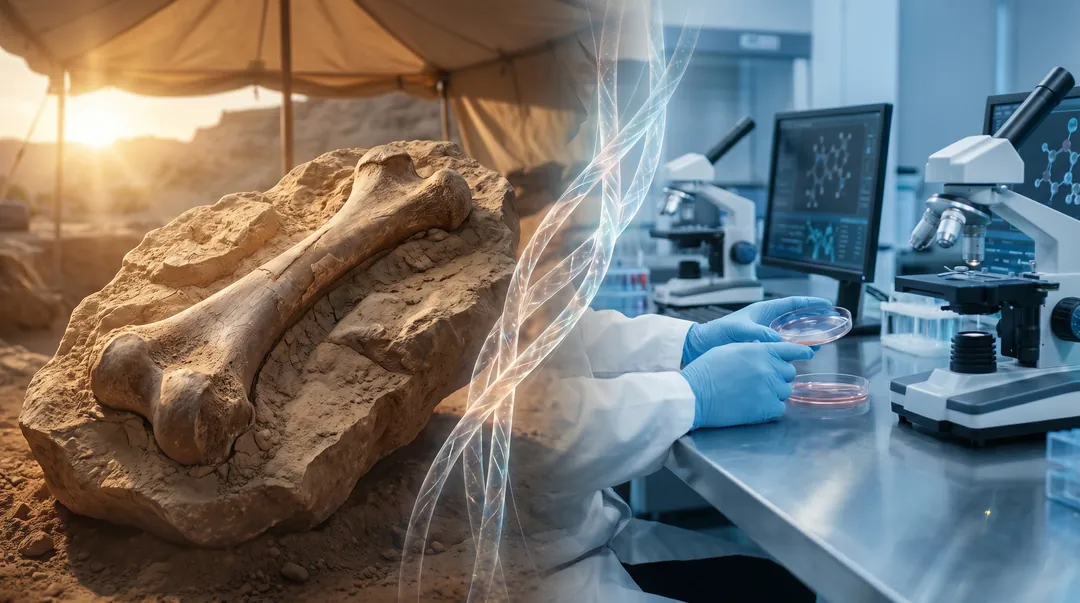
Sixty-six million years represents roughly 2.1 trillion days—enough time for continents to drift, seas to rise and fall, and entire ecosystems to compress into geology. By every conventional law of molecular decay, the collagen and proteins inside dinosaur bones should have hydrolyzed into unrecognizable chemistry long before the first primates appeared. Yet the most contentious question gripping paleontology today is whether some of those original molecules stubbornly survived, sealed within mineralized cavities like messages in a bottle that refuse to dissolve.
What began two decades ago as a handful of shocking claims—microscopic soft tissues and protein remnants recovered from Cretaceous fossils—has not settled into comfortable consensus. Instead, it has become a discipline-defining controversy that reverses direction with each technical refinement. One season brings immunological evidence and mass spectrometry data suggesting authentic dinosaur peptides; the next brings counter-evidence attributing the same signals to microbial biofilms, modern contamination, or geochemical mimicry. The field is not merely divided; it is caught in a methodological spiral where every provisional answer regenerates a harder, more precise question.
The analytical challenge sits at the boundary of chemistry and taphonomy. Collagen, the fibrous structural protein that once gave dinosaur bones their flexibility, is notoriously fragile. In ideal laboratory conditions, it breaks down over centuries. In the wild, microbial digestion, groundwater chemistry, and thermal history should erase it entirely over geological time. Proponents of deep-time survival argue that iron-mediated crosslinking and rapid mineral encapsulation can stabilize peptide fragments, locking them inside bioapatite structures that act as molecular prisons. Iron, released from hemoglobin during decomposition, may function as a natural fixative—a chemical mummification process at the microscopic scale. Critics counter that the same mineral matrix is porous enough to admit bacteria, groundwater proteins, and laboratory contaminants, while simultaneously providing a scaffold for modern biofilms to colonize in ways that mimic ancient tissue architecture.
From a computational perspective, the debate looks less like a fossil hunt and more like a signal-to-noise crisis operating at the absolute edge of instrument sensitivity. Advanced mass spectrometry can now identify peptide sequences at femtomolar concentrations, but sensitivity is a double-edged sword. The difference between a 66-million-year-old archosaurian collagen fragment and a contaminant introduced by handling, packaging, or airborne modern proteins often comes down to subtle variations in mass-to-charge ratios and fragmentation patterns. Machine learning models are increasingly being deployed to filter these datasets, yet they inherit a subtle but profound bias: most training databases are overwhelmingly populated by extant organisms. An algorithm optimized to recognize modern vertebrate collagen may automatically discard a genuinely ancient sequence as anomalous noise, precisely because its chemical signatures have drifted or degraded in ways not represented in contemporary biology.
This is where the reversals become instructive rather than merely confusing. Each apparent flip in the paleontological consensus reflects not sloppy science, but the growing pains of a field inventing new epistemological standards in real time. Early immunological studies relied on antibodies binding to fossil extracts—a technique vulnerable to cross-reactivity with modern biofilms and bacterial proteins. Later work turned to in situ mapping and time-of-flight mass spectrometry to localize candidate peptides within the bone matrix itself, only to face criticism that the detected sequences were too short to rule out statistical coincidence or microbial mimicry. More recently, spatially resolved proteomics and AI-driven sequence validation have attempted to bridge the gap, though they remain contested by researchers who argue that contamination can never be fully excluded when working with specimens exposed to surface environments and decades of museum handling.
The heterogeneity of the fossil record itself fuels the uncertainty and makes replication the central battleground. Not all bones preserve equally. Some Cretaceous specimens contain microstructures resembling blood vessels and osteocytes; others of identical age and provenance are entirely lithified, with no trace of organic residue. If original proteins can survive, they do so under conditions that remain poorly understood—perhaps requiring a rare confluence of rapid burial, specific iron-rich groundwater chemistry, minimal thermal alteration, and exclusion of oxygen. This inconsistency makes broad replication nearly impossible. A result obtained from one exceptionally preserved hadrosaur femur cannot be generalized to the broader record, leaving the field dependent on rare outliers that defy easy statistical modeling.
Yet the controversy is already reshaping paleontology in constructive and irreversible ways. The search for ancient biomolecules has forced traditional bone hunters to engage deeply with analytical chemistry, geochemistry, and data science. Laboratories now operate under stricter contamination protocols borrowed from ancient DNA studies, including clean-room extraction, isotopic negative controls, and protease blanking that were rarely used in morphological paleontology a generation ago. Open-data repositories for fossil proteomics are emerging, allowing independent groups to reanalyze raw mass spectra rather than trusting published peptide lists—a transparency that accelerates correction and reduces the latency of scientific reversal.
Looking forward, the resolution will likely depend on convergence rather than isolation. No single peptide sequence, however convincingly mapped, is likely to end the debate. What is needed is independent lines of evidence—geochemical signatures of antiquity such as advanced racemization patterns or stable isotope profiles inconsistent with modern biology; mineralogical contexts that physically preclude modern infiltration; and computational models trained explicitly on degraded, deep-time chemistry rather than extant biology. If original dinosaur collagen is ever accepted as proven, it will be because chemists, taphonomists, and machine-learning systems agreed simultaneously that the signal is real, the mineral context is sealed, and the noise is fully accounted for.
Key Takeaways
- Provenance Over Presence: The central debate has shifted from whether collagen-like molecules can be detected in dinosaur bones to whether those molecules are genuinely 66 million years old or represent modern contamination, microbial mimicry, and biofilm infiltration.
- Methodology Defines Conclusions: Each major reversal in the field has closely tracked the introduction of new analytical technologies. Molecular paleontology is learning that its questions are now inseparable from the instruments and algorithms used to ask them.
- The AI Signal-to-Noise Problem: Machine learning offers powerful filtering capabilities, but algorithms trained on modern biological databases risk dismissing authentic ancient chemistry as anomalous noise, highlighting the urgent need for degradation-aware training data and fossil-specific computational frameworks.
- Heterogeneity as a Scientific Barrier: The fossil record is not uniform. Exceptional preservation in isolated specimens provides tantalizing clues that remain difficult to replicate or generalize across broader taxonomic and geological contexts, making statistical certainty elusive.
- Reversals as Disciplinary Progress: The repeated upheavals in molecular paleontology reflect a healthy, maturing discipline tightening its standards. What looks like confusion from the outside is rigorous self-correction operating under unprecedented analytical scrutiny.
The bones themselves are silent. It is the frameworks we bring to them—chemical, computational, and conceptual—that are being tested and transformed. Whether or not original collagen truly endures from the Cretaceous, the hunt has already dissolved old boundaries between geology and molecular biology. The question may be 66 million years old, but today, the answer is still being written.