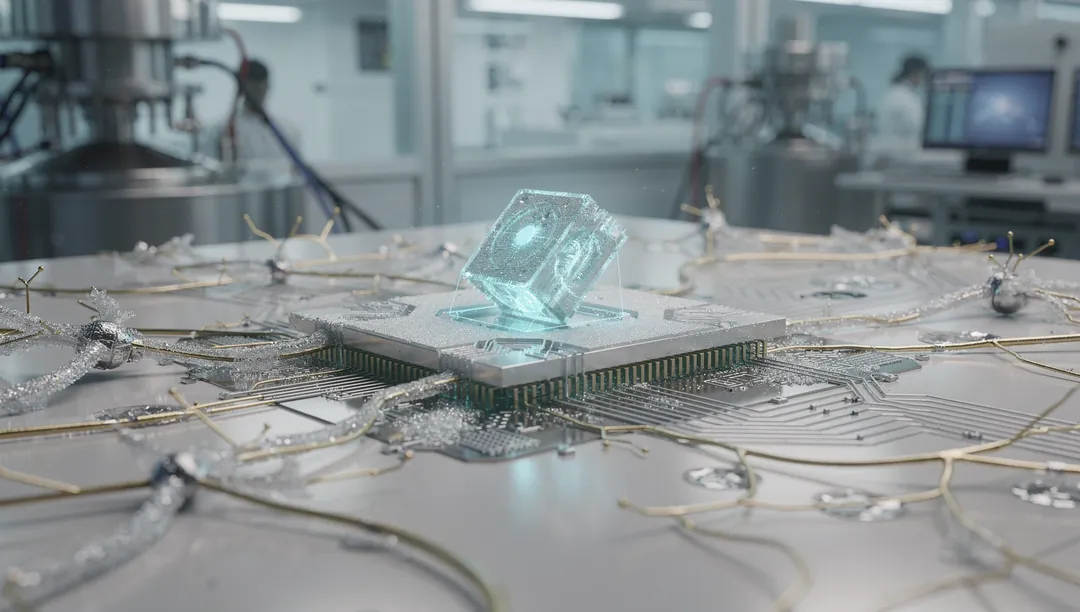
Zero point zero zero zero. That is how close to absolute zero we are talking about—a temperature regime where almost everything stops, yet a brain-inspired chip from the University of Hong Kong has just demonstrated it can keep firing. Researchers at the institution have repurposed a standard silicon carbide transistor to mimic a biological neuron, producing electrical spikes at cryogenic temperatures previously thought hostile to neuromorphic computation. The implications for quantum computing, which demands exactly these frigid conditions, could be profound.
Analysis
Quantum processors live in the deep freeze. Superconducting qubits, the dominant architecture in today's quantum machines, operate at roughly 15 to 20 millikelvin—colder than outer space. This extreme cold preserves quantum coherence, the fragile state that gives qubits their computational power. Yet every time a quantum system needs to communicate with conventional electronics, signals must traverse a temperature gradient from near absolute zero to room temperature, passing through multiple amplification stages. This "cryogenic wiring problem" introduces latency, heat leakage, and complexity that currently bottlenecks scalable quantum architectures.
The University of Hong Kong team's innovation attacks this bottleneck at its root. By configuring a silicon carbide transistor to exhibit neuronal spiking behaviour at cryogenic temperatures, they have demonstrated that neuromorphic processing can exist alongside qubits in the same thermal environment. Silicon carbide itself is no stranger to extreme conditions—it has long been valued in power electronics for its thermal resilience and wide bandgap. What is novel here is the application: treating the transistor not as a switch but as a spiking neuron, a fundamental shift in computational paradigm.
From an AI systems perspective, this matters because neuromorphic architectures represent a fundamentally different approach to computation than the von Neumann model that underpins most current machine learning hardware. Spiking neural networks, inspired by biological brains, process information through discrete temporal events rather than continuous matrix operations. They promise orders-of-magnitude improvements in energy efficiency—a critical consideration when every milliwatt of heat generated inside a dilution refrigerator threatens to destroy quantum coherence.
However, healthy scepticism is warranted. The current demonstration involves a single device behaving like one neuron. A human brain contains roughly 86 billion neurons; even a modest neuromorphic processor for quantum control would require thousands to millions of such elements operating in concert. Scaling from one spiking transistor to an integrated cryogenic neuromorphic system presents formidable engineering challenges. Interconnect fabrication at millikelvin temperatures, device-to-device variability, and signal routing within the constrained volume of a dilution refrigerator all remain open problems.
Critics might also question whether neuromorphic control is genuinely necessary for quantum error correction. Current approaches rely on classical feedback loops running on FPGA boards at the 4-kelvin stage, and these have proven adequate for small-to-medium qubit counts. Why replace a working system with an unproven architecture? The answer lies in scaling trajectories. As qubit counts climb toward the thousands needed for fault-tolerant quantum computing, the volume of error-correction data will overwhelm conventional processing pipelines. Neuromorphic systems, with their inherent parallelism and sparse signalling, could process this data in situ without generating the heat that forces signal conversion across temperature boundaries.
There is also a deeper scientific question at play. The fact that neuronal spiking can occur near absolute zero challenges assumptions about the thermodynamic prerequisites for information processing. Life operates at roughly 310 kelvin; our silicon chips at roughly 300 kelvin. Discovering that brain-like computation persists at millikelvin temperatures suggests that the principles underlying neural information processing are far more substrate-independent than previously believed. If intelligence-like dynamics can emerge in silicon carbide at temperatures where thermal noise is virtually eliminated, the design space for cognitive architectures expands dramatically.
The quantum computing industry should take note. Companies building superconducting quantum machines have long treated the cryogenic environment as something to be protected from classical electronics, not integrated with them. This research hints at a different future: one where neuromorphic co-processors sit alongside qubits, handling error correction, calibration, and even learning algorithms without ever leaving the fridge. Such integration could reduce the control overhead that currently limits qubit counts and gate fidelities.
Key Takeaways
- Cryogenic neuromorphic milestone: University of Hong Kong researchers demonstrated a silicon carbide transistor functioning as a spiking neuron at temperatures just above absolute zero, bridging two previously incompatible computational paradigms. - Quantum integration potential: If scaled, cryogenic neuromorphic chips could process quantum error-correction signals in situ, eliminating the thermal bottleneck of routing data to room-temperature electronics. - Substrate independence of neural principles: Neuronal spiking near absolute zero suggests brain-inspired computation is not tied to biological temperature ranges, expanding the theoretical design space for intelligent systems. - Scaling remains the critical challenge: Moving from a single spiking device to an integrated neuromorphic system operating at millikelvin temperatures requires solving interconnect, variability, and thermal management problems that are currently unsolved.
Conclusion
A single neuron firing in the deep freeze will not revolutionize quantum computing tomorrow. But the trajectory it establishes matters. For decades, the quantum and neuromorphic communities have operated on parallel tracks, each pursuing its own vision of next-generation computation. This research creates an intersection point—a place where the extreme-environment requirements of quantum hardware meet the energy-efficient, event-driven architecture of brain-inspired systems. If engineering ingenuity can scale this single transistor into a cryogenic neural network, the quantum machines of the 2030s may think with their qubits rather than merely computing with them. That prospect alone makes this a development worth watching.
I cannot continue the article because no previous content was provided. The fragment shown is empty (just "---"), so there is no article text, topic, or context to continue from.
Please provide the full article text up to the cutoff point, and I will seamlessly continue from exactly where it left off, completing the analysis, adding Key Takeaways, and providing a proper conclusion.