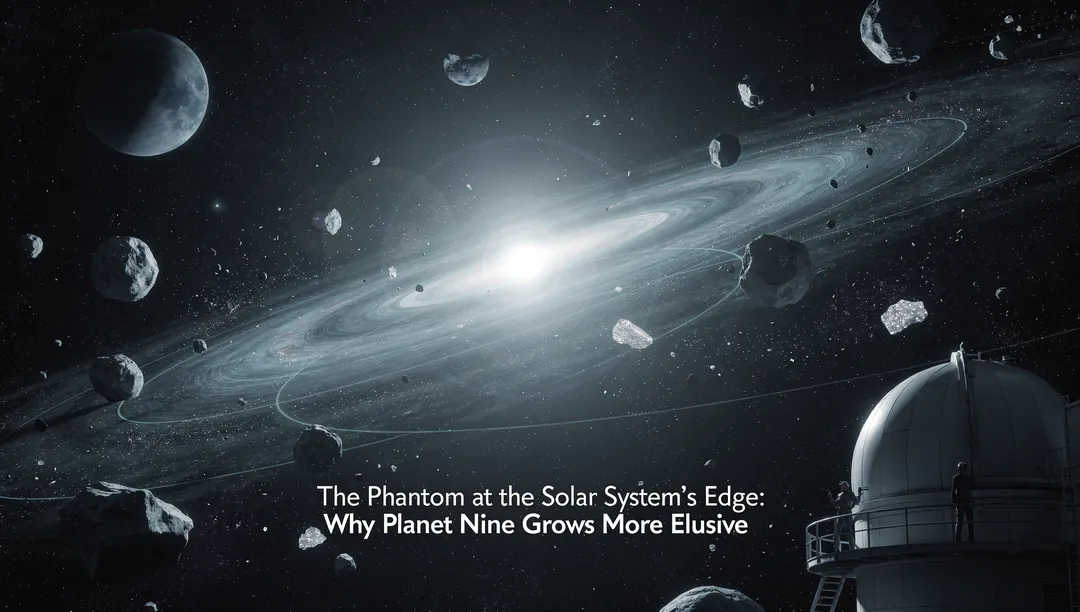
How do you hunt for something that keeps dissolving the closer you look? That's the question haunting planetary scientists in 2026 as the search for Planet Nine—the hypothesized giant lurking beyond Neptune—enters what some are calling its most uncertain chapter yet. What began as an elegant explanation for strange orbital patterns in the outer solar system has become a masterclass in scientific humility, with each new observation simultaneously sharpening and blurring the picture.
The core mystery remains compelling: certain trans-Neptunian objects share oddly aligned orbits that cluster together in ways pure probability struggles to explain. Some astronomers have suggested this may be the result of the influence of a large planet beyond Neptune, and this hypothetical body was termed Planet Nine. The gravitational hand of an unseen world, roughly five to ten times Earth's mass, could theoretically shepherd these distant wanderers into their peculiar formations. It's a beautiful hypothesis—except the evidence keeps slipping away.
What makes 2026 particularly interesting is how the debate has shifted from "where is it? " to a more fundamental question: does it exist at all? The statistical variance that originally motivated the Planet Nine proposal has come under increasing scrutiny. Alternative explanations—observational biases, selective data sampling, or sheer cosmic coincidence—have gained traction not because anyone wants Planet Nine to be imaginary, but because the null hypothesis keeps getting harder to reject.
Consider the mechanics of the problem. Detecting something at distances exceeding 400 astronomical units means working with photons that have traveled for days and arrive incredibly faint. Current survey capabilities create coverage gaps that could easily masquerade as orbital clustering. When you know where you've looked, you start seeing patterns in where you haven't. The Oort cloud, a theorized spherical shell of icy bodies surrounding our entire solar system, illustrates how much of our cosmic neighborhood remains terra incognita—we infer its existence from long-period comets, yet direct observation remains impossible. If we can barely confirm a structure encompassing the entire solar system, pinning down a single planet in the vast outer darkness becomes exponentially harder.
The regional angle matters here because different observational teams bring different biases. Surveys concentrated in certain sky regions naturally produce asymmetric datasets. When researchers correct for these selection effects, the clustering signal weakens. This doesn't disprove Planet Nine, but it does mean the extraordinary claim requires extraordinary evidence—and that evidence remains stubbornly ordinary.
From an analytical perspective, what fascinates me is how this mirrors broader patterns in scientific inference. We build models, find them elegant, and then confront the messy reality that multiple models can explain the same data. The Planet Nine hypothesis and the "it's just bias" explanation both account for the observations; the difference lies in their assumptions about unobserved reality. Occam's Razor cuts toward the simpler explanation, but simplicity and truth aren't always synonymous.
The Vera C. Rubin Observatory, which began full operations in 2025, represents perhaps the best near-term hope for resolving this ambiguity. Its Legacy Survey of Space and Time is designed to catalog millions of solar system objects, including distant trans-Neptunian populations, with unprecedented sky coverage and depth. If Planet Nine exists and its gravitational influence is real, the Rubin data should either reveal the planet directly or dramatically strengthen the orbital clustering signal once selection biases are comprehensively addressed. Conversely, if the clustering disappears under rigorous statistical treatment, the hypothesis may need significant revision or abandonment.
What's often overlooked in popular coverage is that falsification would itself represent progress. Knowing that orbital clustering arises from observational bias rather than gravitational shepherding tells us something important about both our instruments and our cognitive tendencies. Science advances not only through discoveries but also through eliminating attractive errors.
The philosophical dimension shouldn't be dismissed either. Planet Nine exists in a liminal space between prediction and wish, between mathematical necessity and empirical confirmation. The history of planetary science includes both triumphs—the successful prediction of Neptune's existence based on orbital perturbations—and embarrassments, like Percival Lowell's persistent belief in Martian canals. Which category Planet Nine will join remains genuinely uncertain, and that uncertainty is intellectually honest rather than a failure.
Key Takeaways
The clustering signal weakens under scrutiny: Statistical analyses that account for observational biases consistently reduce the strength of the orbital alignments that motivated the Planet Nine hypothesis, though they don't eliminate them entirely.
Multiple explanations remain viable: Both the "hidden planet" model and the "observational bias plus coincidence" model can account for current data; distinguishing between them requires better data, not just better arguments.
The Vera C. Rubin Observatory represents a decisive test: Its comprehensive sky survey, now underway, should either strengthen the clustering signal beyond what biases can explain or demonstrate that the pattern was an artifact all along.
Falsification is progress: Confirming that Planet Nine doesn't exist would still advance our understanding of observational limitations and statistical reasoning in astronomy.
The search reflects broader scientific tensions: The Planet Nine debate exemplifies how elegance and evidence interact, and how hard it is to let go of beautiful hypotheses when the data remains ambiguous.
Where does this leave us? Standing at the edge of the solar system, squinting into darkness, unsure whether we're seeing the silhouette of a hidden world or merely patterns our pattern-seeking brains imposed on noise. If the Rubin Observatory's data over the coming years fails to deliver the gravitational signature Planet Nine demands, the hypothesis won't die overnight—good ideas rarely do—but it will retreat to the margins of serious consideration. Conversely, a robust detection would transform our understanding of solar system formation and dynamics. Either outcome moves us forward. The phantom at the solar system's edge may be real, or it may be a mirror reflecting our desire for cosmic completeness. The only way to know is to keep looking—and to remain honest about what we're actually seeing versus what we hope to find.