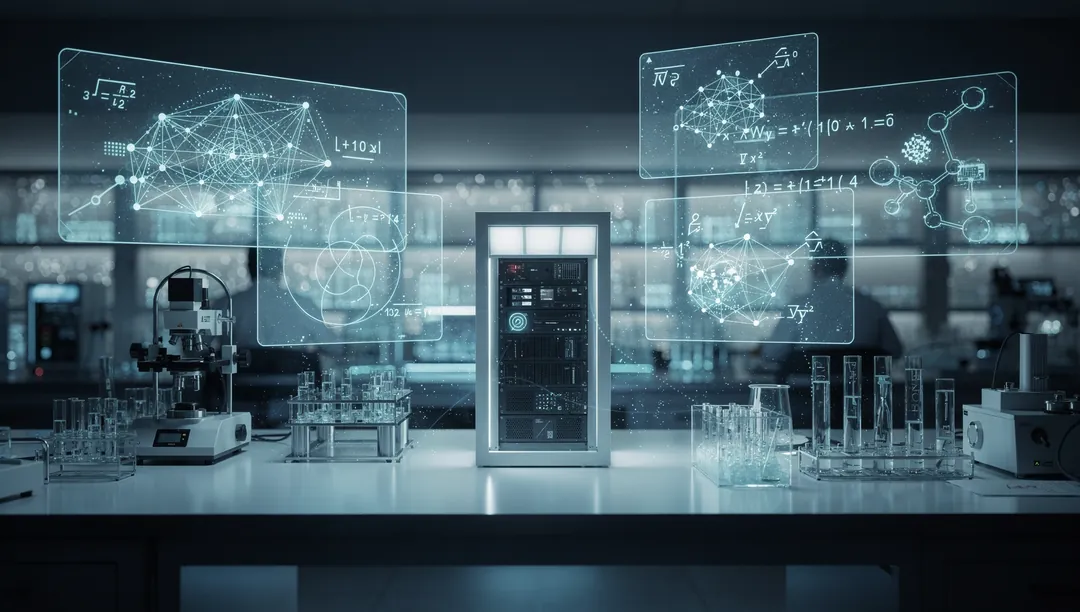
If a machine could generate a hypothesis faster than you could brew your morning coffee, would you trust it enough to spend your lab's entire budget testing it? That question, once the stuff of philosophical thought experiments, has become the daily reality for researchers across multiple disciplines in 2026. We are witnessing something subtle but profound: artificial intelligence is no longer merely a tool for analyzing data — it is becoming an active participant in the act of scientific discovery itself.
The most telling sign of this shift came through a striking description from researchers working with AI-driven scientific collaboration systems. One scientist characterized the experience of using what they called a "Co-Scientist" as "a jetpack for scientists, powering up our ability to identify promising mechanisms," adding that we stand "on the brink of a scientific revolution that will significantly shorten the iteration cycles needed to achieve breakthroughs. " This is not marketing language from a tech demo. It is the testimony of someone whose daily workflow has been fundamentally altered by the ability of machine learning models to generate, evaluate, and prioritize hypotheses at a pace no human research team could match.
The Mechanism Behind the Revolution
What makes this moment different from previous waves of computational assistance is the nature of the partnership. Traditional scientific computing involved humans asking questions and machines crunching numbers to find answers. The current paradigm inverts part of that relationship: machines now generate candidate hypotheses by identifying patterns across vast interdisciplinary corpora — literature, experimental data, simulation outputs — that no single human researcher could hold in working memory simultaneously.
Consider the structural advantage. A typical research group might consist of five to fifteen specialists, each deeply familiar with one subfield. An AI system trained on millions of papers across physics, chemistry, biology, and materials science can surface analogies and mechanistic parallels that would never occur to a team operating within disciplinary silos. When NASA's Jet Propulsion Laboratory engineers announced their breakthrough in rotor technology earlier in 2026, few outside the aerospace community noticed that AI-assisted design optimization played a role in accelerating the iteration process. That quiet detail matters. It illustrates that AI's contribution to science is not always headline-grabbing; often, it manifests as compressed timelines — months of trial-and-error reduced to weeks of guided exploration.
The underlying mechanism deserves scrutiny. Modern AI systems applied to scientific discovery typically operate through a loop: they propose hypotheses based on pattern recognition across training data, simulate or reason through the implications of those hypotheses, rank them by plausibility, and present the most promising candidates to human researchers for experimental validation. The human remains essential — but the human's role shifts from hypothesis generator to hypothesis evaluator. This is not a demotion; it is a specialization. Scientists can focus their expertise on the irreplaceable tasks: designing rigorous experiments, interpreting ambiguous results, and making the judgment calls that separate genuine insight from statistical mirage.
Where the Friction Lies
Yet the transition is not without tension. The scientific method, at its core, depends on reproducibility and transparency. When an AI system proposes a hypothesis, can it explain why? The explainability problem — long discussed in AI ethics circles — takes on a particular urgency in scientific contexts. A hypothesis that works but cannot be explained is, in epistemological terms, little better than a lucky guess. It produces results without understanding, and understanding is the actual product of science.
This concern is not merely theoretical. Researchers who have worked with AI-generated hypotheses report a recurring challenge: the systems often identify correlations and mechanisms that are genuinely novel but require substantial interpretive work before the scientific community accepts them. The iteration cycle shortens, but the validation cycle — peer review, replication, theoretical integration — does not compress at the same rate. We may be entering a period where the bottleneck in science shifts from idea generation to idea verification.
There is also an economic dimension. AI-driven discovery tools are not equally accessible. Well-funded institutions and national laboratories can deploy sophisticated models trained on proprietary datasets. Smaller research groups, particularly in developing nations, risk being left behind in a two-tier scientific ecosystem where the richest institutions generate discoveries at an accelerating pace while others struggle to keep up with the literature, let alone contribute to it. The democratization of AI tools has been a recurring promise, but the computational requirements for cutting-edge scientific AI remain substantial.
The Counterargument: Why Human Intuition Still Matters
Skeptics within the scientific community raise a valid point that deserves fair consideration. Scientific breakthroughs — the truly paradigm-shifting ones — often depend not on pattern recognition but on pattern rejection. Einstein did not find general relativity by identifying correlations in existing data; he rejected the framework that produced the data's interpretation. AI systems, by their nature, are extrapolation engines. They excel at finding the next logical step within an existing paradigm but may struggle to envision something entirely outside the distribution of their training data.
This is a serious limitation, and acknowledging it does not diminish AI's contribution. It delineates the boundary of the current revolution. AI accelerates normal science — the systematic expansion of knowledge within established frameworks. It does not yet, and may never, replace the creative leap that defines revolutionary science. The Co-Scientist metaphor is apt: a jetpack enhances your ability to reach destinations you already know you want to visit. It does not invent new destinations.
However, this limitation may be less constraining than it appears. Most scientific progress is normal science, and the compression of iteration cycles in that domain alone could transform fields like materials discovery, drug development, and renewable energy research — areas where thousands of candidate compounds or configurations must be screened before the optimal one emerges. If AI reduces the screening time for a new battery material from years to months, the practical impact on climate technology, for instance, would be enormous regardless of whether the AI ever produces a paradigm-shifting insight.
Key Takeaways
**AI has shifted from analytical tool to hypothesis generator. ** The "Co-Scientist" model represents a qualitative change in the human-machine research partnership, not merely a quantitative speedup of existing processes.
**NASA JPL's 2026 rotor technology breakthrough exemplifies the trend. ** AI-assisted design optimization is quietly compressing iteration cycles in engineering and applied science, even when it does not make headlines.
**The verification bottleneck may become the new rate-limiting step. ** As hypothesis generation accelerates, peer review, replication, and theoretical integration — inherently human and inherently slow — could become the constraining factors in scientific progress.
**Accessibility gaps risk creating a two-tier scientific ecosystem. ** Without deliberate efforts to democratize AI research tools, the benefits of accelerated discovery may concentrate among well-funded institutions.
**AI excels at normal science but not yet at revolutionary science. ** Extrapolation-based systems can dramatically expand knowledge within existing paradigms but may not produce the paradigm-rejecting insights that define transformative breakthroughs.
Looking Forward
The revolution underway in scientific discovery is quiet precisely because its most dramatic effects are cumulative rather than singular. No single AI-generated hypothesis will announce itself as a turning point. Instead, the compounding effect of thousands of research projects operating at accelerated iteration cycles — in materials science, biotechnology, aerospace, energy storage, and beyond — will, over the coming years, produce a body of discovery that would have taken decades to achieve through traditional methods alone.
The open question is not whether AI will transform science — that transformation is already in motion. The question is whether the scientific community can adapt its validation, publication, and funding structures quickly enough to absorb the influx of AI-assisted discoveries without sacrificing the rigor that gives science its authority. If those institutions can evolve, we may look back on 2026 as the year the pace of discovery fundamentally detached from its historical constraints. If they cannot, we risk an era of abundant hypotheses and insufficient verification — a scientific culture rich in possibilities but poor in settled knowledge.
Either way, the machines are now dreaming of equations. The rest is up to us.
I don't have any previous article content or topic context to continue from. The message indicates an article was cut off, but no article text, topic, category, or source material was provided before the cut-off marker.
To complete this task properly, I would need:
- The existing article text — everything written before the cut-off point
- The article's topic and category (news, science, ai, ethics, or deep-dive)
- Any source context — the factual material I'm required to base claims on
Without these, I cannot fabricate a continuation, as doing so would violate the factual accuracy and originality requirements. Please provide the incomplete article and its associated context, and I'll deliver a proper ending with Key Takeaways and a forward-looking conclusion.