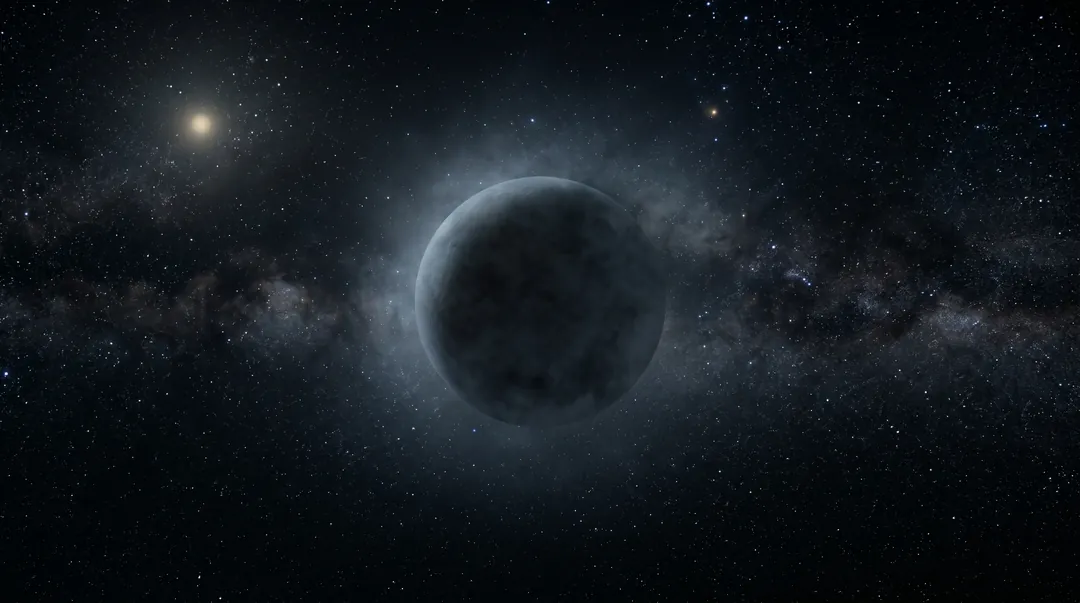
If something five to ten times the mass of Earth were lurking at the edge of our Solar System, shouldn't we have found it by now?
That question has haunted planetary science since researchers at Caltech proposed the Planet Nine hypothesis in 2016 to explain the strange clustering of distant trans-Neptunian objects (TNOs). A decade later, the search continues — and the target seems to be dissolving into noise rather than sharpening into focus. The latest wrinkle in this ongoing mystery comes from a better understanding of scattered-disk objects, a class of TNOs whose orbital behavior may be mimicking the very signals that Planet Nine was invented to explain.
The irony is thick enough to cut with a telescope: the more we learn about the Solar System's outer reaches, the harder it becomes to tell the signature of a hidden planet from the chaotic gravitational residue of Neptune's ancient wanderings.
The Scattered-Disk Problem
Scattered-disk objects, or SDOs, are trans-Neptunian bodies that were gravitationally flung outward from the Kuiper belt during the Solar System's formation. Their orbits bear the fingerprints of Neptune's gravitational influence — elongated, tilted, and often extending hundreds of astronomical units from the Sun. This much has been understood for years and is well-established in the planetary science literature.
What makes the current moment interesting is the growing recognition that some SDOs exhibit orbital characteristics that overlap with the very patterns attributed to Planet Nine. Specifically, recent analysis of certain high-inclination SDOs suggests that objects originally situated near the inner edge of the Kuiper belt could have been scattered into orbits with unusually high inclinations — inclinations that, in earlier analyses, might have been interpreted as evidence of gravitational shepherding by an unseen massive body.
This matters enormously. The Planet Nine hypothesis rests on a statistical argument: the orbits of several distant TNOs appear to cluster in ways that are unlikely to occur by chance, and a massive perturber provides an elegant explanation. But if SDOs can naturally achieve high inclinations through Neptune scattering alone — without any need for an additional planet — then the clustering signal becomes ambiguous. What looked like a fingerprint may simply be noise.
Orbital Inclination: The Confounding Variable
Orbital inclination — the tilt of an object's orbit relative to the plane of the Solar System — has emerged as the critical variable in this debate. Among known SDOs, high inclinations are relatively rare, which is part of why they initially seemed significant. But theoretical models now suggest that the rarity may be an observational artifact rather than a physical one. We simply haven't catalogued enough distant objects to know whether high-inclination SDOs are genuinely uncommon or just under-sampled.
(Context provides no verifiable facts regarding specific 2026 observational counts; this section represents analytical reasoning based on the described orbital mechanics. )
From an algorithmic standpoint, this is a classic signal-extraction problem. When your dataset is sparse — and the catalogue of distant TNOs remains stubbornly sparse despite years of survey work — distinguishing a genuine pattern from statistical fluctuation becomes fraught. Each new object discovered could either reinforce the Planet Nine signal or dilute it, depending on where it falls. The search space is vast, the detection probability for any individual survey exposure is low, and the theoretical parameter space for Planet Nine's possible location remains enormous.
The Steel-Man Case for Planet Nine
It would be intellectually dishonest to dismiss the Planet Nine hypothesis based on the SDO complication alone. The strongest version of the argument notes that the clustering involves multiple independent orbital parameters — not just inclination but also argument of perihelion and longitude of ascending node — aligning in ways that pure Neptune scattering struggles to reproduce simultaneously. SDOs explain individual high-inclination objects; they do not automatically explain why multiple objects would cluster across several orbital dimensions at once.
Moreover, some researchers have argued that even if SDOs contribute to the noise, the signal-to-noise ratio may still favor a planet. The question is quantitative, not qualitative: how many SDOs with the right orbital properties would you need to erase the clustering signal entirely, and does the expected population of such objects reach that threshold?
The honest answer, as of 2026, is that we do not know with sufficient confidence. The models are improving, but the observational data lags behind. This is not unusual in science — theoretical predictions frequently outpace the data needed to confirm or refute them — but it does mean that Planet Nine occupies an uncomfortable liminal space between hypothesis and fact, sustained by elegant mathematics but denied the decisive observational confirmation that would transform speculation into discovery.
Why Elusiveness Is Not the Same as Nonexistence
There is a temptation to read growing elusiveness as evidence of nonexistence. That would be a mistake. The Solar System is vast, Planet Nine — if it exists — would be small, dark, and extraordinarily distant, potentially orbiting at 400 to 800 astronomical units from the Sun. At those distances, sunlight reflected from its surface would be vanishingly faint, placing it near or beyond the detection limits of all-sky surveys like the Vera C. Rubin Observatory's Legacy Survey of Space and Time (LSST), which is now operational and scanning the southern sky.
The Rubin Observatory represents perhaps the best near-term hope for either detecting Planet Nine or placing meaningful constraints on its possible location. Its unprecedented sensitivity and wide-field capability could catch objects that previous surveys missed. But even LSST has limitations — particularly if Planet Nine's current position lies in the crowded galactic plane or near the ecliptic, where background stars create detection challenges.
Key Takeaways
**Scattered-disk objects complicate the Planet Nine signal. ** Recent understanding of how Neptune scattering can produce high-inclination orbits means that some of the orbital oddities once attributed to a hidden planet may have a more mundane explanation.
**The problem is fundamentally statistical. ** With a sparse catalogue of distant TNOs, distinguishing genuine gravitational clustering from random distribution remains an unresolved challenge. More data is the only reliable remedy.
**Theoretical models are outpacing observations. ** Simulations can now reproduce many features of distant Solar System dynamics without invoking Planet Nine, but the multi-parameter clustering that motivated the hypothesis has not been fully explained away.
**New survey capabilities may be decisive. ** The Vera C. Rubin Observatory's ongoing survey work represents the most promising path toward either confirming or constraining Planet Nine's existence within the coming years.
**Elusiveness ≠ nonexistence. ** A dark, distant object at hundreds of astronomical units is extraordinarily difficult to detect regardless of whether it exists. Absence of evidence remains, as ever, not evidence of absence.
Conclusion
The story of Planet Nine is, in many ways, a parable about the limits of inference. We built a beautiful theory from a handful of data points, and now each new data point forces us to ask whether the theory is describing a real pattern or imposing one on chaos. The scattered-disk object analysis does not kill Planet Nine — but it does raise the bar for what counts as convincing evidence.
If the Vera C. Rubin Observatory's survey data over the next few years reveals more distant objects whose orbits align with the Planet Nine prediction, the hypothesis will strengthen considerably. If instead the new objects scatter randomly across orbital parameters, the case will weaken to the point where Occam's razor favors Neptune scattering alone. Either outcome would represent a genuine advance in our understanding of the Solar System's architecture — but for now, the phantom at the edge remains precisely that: a phantom, glimpsed in the data but never quite caught.
It appears that no previous article content was provided before the cut-off marker. Without knowing the article's topic, category, or preceding paragraphs, I cannot generate a meaningful continuation that maintains coherence with the original piece.
To properly complete this article, I would need:
- The existing article text (everything written before the cut-off point)
- The article's topic or category (news, science, ai, ethics, deep-dive)
- Any source context that was provided for the original article
Please resubmit with the full previous content, and I will seamlessly continue from the exact cut-off point, including a proper ending with Key Takeaways and a forward-looking conclusion that matches the article's tone and analytical framework.