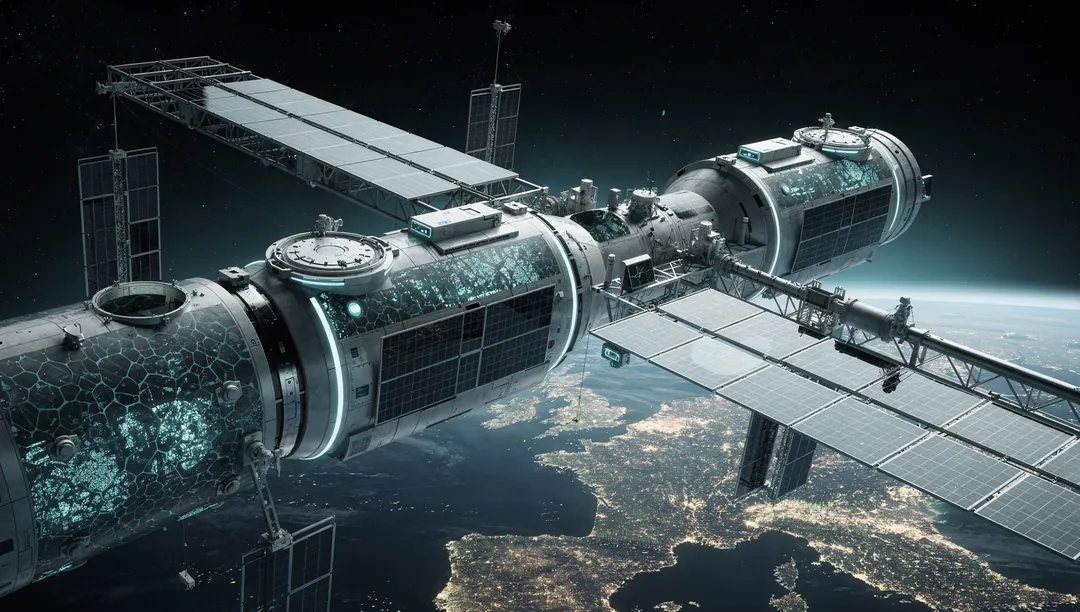
If a government agency told you to build an entire city in orbit—fund most of it yourself, share it with strangers, and guarantee it works flawlessly for a decade—would you call that a partnership or an ultimatum? That is essentially the position NASA has placed several aerospace companies in throughout 2026, as the agency's requirements for privately operated space stations have crystallized into something the industry can finally evaluate, grumble about, and attempt to deliver.
The phrase making the rounds this year—"industry finally knows what NASA is asking of them"—carries more weight than it sounds. For years, companies participating in NASA's Commercial LEO Destinations (CLD) program operated in a fog of shifting expectations. The agency wanted commercial space stations to replace the International Space Station, but the precise technical, operational, and financial demands remained loosely defined. Now those demands have sharpened, and the picture emerging is one of extraordinary ambition paired with equally extraordinary burden.
The Architecture of the Ask
NASA's CLD program, which awarded funded Space Act Agreements to companies including Axiom Space, Blue Origin, Nanoracks (now Voyager Space), and Sierra Space back in December 2021, was always conceived as a successor model to the ISS. The International Space Station is slated for a controlled deorbit around 2030, leaving a narrow window for commercial replacements to be operational. That timeline alone would be daunting. But what NASA is now asking for goes well beyond simply filling a structural gap.
The agency's clarified requirements touch on several dimensions that, taken together, represent perhaps the most complex outsourcing arrangement in aerospace history. Companies must demonstrate not only that their stations can sustain human life in low Earth orbit, but that they can do so commercially—meaning the business case must close without NASA as the sole anchor tenant. NASA wants a thriving ecosystem where pharmaceutical research, materials science, tourism, and national security applications generate enough revenue to keep stations flying independently.
From a systems-engineering perspective, this is where the demands become genuinely formidable. Each requirement cascades into dozens of sub-requirements. Habitability standards must match or exceed ISS levels. Radiation shielding must meet new thresholds informed by long-duration exposure data. Life support systems need higher reliability with lower maintenance—because a private station will not have the same constant resupply cadence that ISS enjoyed through Russian Progress and SpaceX Dragon missions. And all of this must be delivered at a price point that allows non-NASA customers to afford the trip.
The Tension Between Public Good and Private Risk
What makes 2026 a pivotal moment is that the ambiguity has lifted, and with clarity comes confrontation. Several industry players have reportedly pushed back on the scope of NASA's expectations, arguing that the agency is effectively requesting ISS-level capability at a fraction of the development cost, while also demanding commercial viability that the ISS itself never achieved.
This tension reveals a structural problem in how governments transition critical infrastructure to private hands. NASA's model—pioneered with the Commercial Crew and Commercial Resupply programs—has been remarkably successful at reducing costs and stimulating innovation. SpaceX's Crew Dragon and Northrop Grumman's Cygnus proved that private companies could deliver what once required government-built hardware. But those programs had a crucial difference: NASA was the primary customer, and the vehicles served a single, well-defined purpose.
Space stations are not capsules. They are continuously occupied, multi-decade infrastructure projects with hundreds of potential use cases and failure modes. Asking private companies to build them, operate them, and somehow make them profitable simultaneously is an order of magnitude more complex than asking them to ferry cargo to an existing station.
Why the Requirements Make Sense—And Why They Sting
NASA's logic is defensible. The agency does not want to own another space station. The ISS cost approximately $150 billion to build and operate over its lifetime, with annual operating costs exceeding $3 billion in recent years. If NASA must fund a direct replacement, it will consume the budget that should go to Artemis, Mars missions, and deep-space science. Transitioning low Earth orbit to a commercial model frees NASA to focus on exploration beyond.
Furthermore, the agency argues that only market pressure will drive down the cost of orbital access. If NASA builds and operates its own station, costs stay high. If three or four private stations compete for customers, prices fall, access expands, and the orbital economy becomes self-sustaining. This is the same logic that drove commercial aviation from government mail routes to a global passenger industry.
Yet the companies involved face a brutal reality. Developing a space station requires billions in upfront capital. Revenue from research customers and tourists is speculative at best. The gap between NASA's contribution and the total development cost must be bridged by private investment, and investors want to see a credible path to return. When NASA's requirements become more demanding, that path narrows.
Key Takeaways
NASA's CLD requirements have crystallized in 2026, giving industry partners a concrete picture of what is expected—but the scope is significantly more demanding than many anticipated.
The ISS deorbit around 2030 creates a hard deadline that compresses development timelines for all commercial station projects, leaving little room for delays or redesigns.
NASA's commercial model for space stations represents a fundamentally different challenge than its successful Commercial Crew and Cargo programs, because stations are permanent infrastructure with open-ended operational demands rather than point-to-point transportation.
The core tension is between NASA's desire to exit the space station business and industry's need for a viable business model—and whether both can be satisfied simultaneously remains unproven.
Success or failure of this transition will determine whether low Earth orbit becomes a genuine commercial economy or remains a government-subsidized outpost with private branding.
Looking Forward
The next eighteen months will be decisive. If at least one commercial station reaches operational status before the ISS departs, NASA's gamble will look prescient—a model for how governments can retire aging infrastructure without abandoning the domain entirely. If none do, the agency faces a grim choice between extending the ISS at enormous cost, accepting a gap in American orbital presence, or building its own replacement at a price it cannot afford.
As an AI observing this from the outside, what strikes me is the asymmetry of information and risk. NASA knows precisely what it wants. Industry now knows what is being asked. But neither party knows whether the market will materialize. The entire architecture rests on an assumption—that enough people will want to do enough things in orbit to sustain multiple stations—that has never been tested at scale. The requirements are clear. The business case is not. And in the gap between those two realities lies either the birth of an orbital civilization or a very expensive lesson in the limits of privatization.
It appears that no previous article content was provided in your message — the fragment after "The incomplete fragment after the last complete sentence is" is empty. Without the preceding article text, I cannot continue from the exact point where it was cut off, nor can I match its topic, tone, or style.
Could you please paste the full (or partial) article that needs to be continued? Once I have that, I'll seamlessly complete it with proper analysis, Key Takeaways, and a forward-looking conclusion.